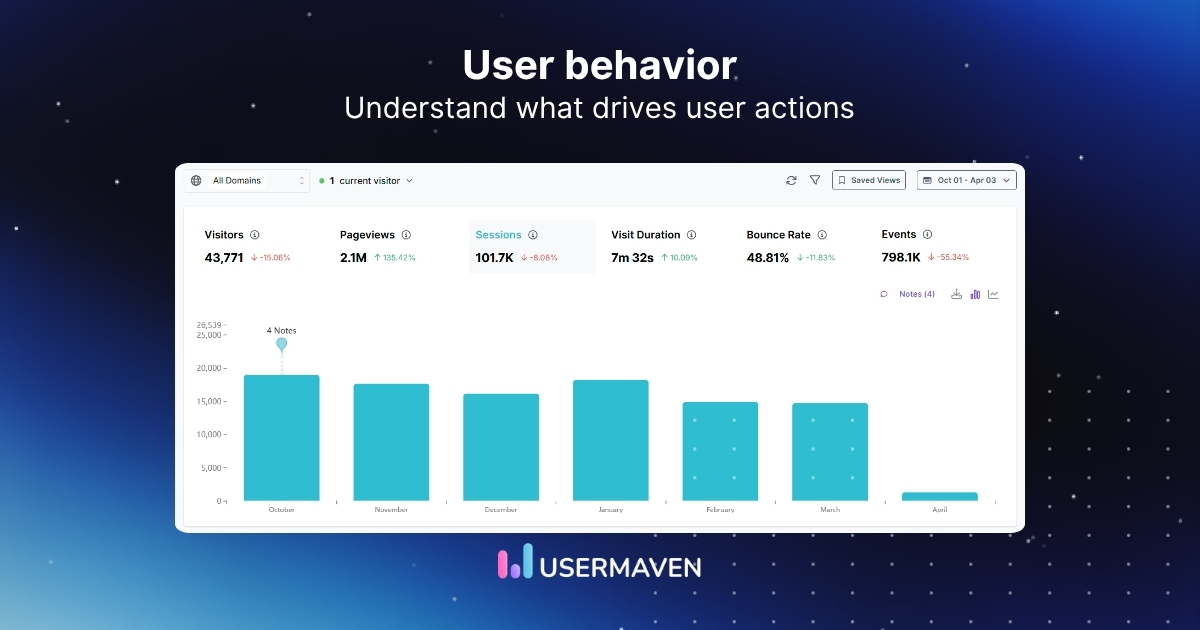
People rarely move through a website or product in a straight line. They compare options, hesitate, leave, return, and make decisions in ways that are often hard to predict.
That is what makes user behavior worth understanding. It reveals the patterns behind how people explore, evaluate, and respond across different stages of the journey.
In this blog, we’ll unpack what user behavior is, what influences it, and how businesses can better understand it.
What is user behavior?
User behavior is the pattern of actions people take across a website, app, or product. It shows how people move through an experience and where their attention starts to build or fade.
These actions are shaped by what users want, what they expect, and how easy the experience feels to navigate. Even a small action can reveal whether something is working for them or getting in the way.
It can show up in signals like:
- Pageviews
- Clicks and scroll depth
- Repeat visits
- Drop-off rate
- CTA engagement
- Path to purchase
User behavior is not just about what people do. It is about what those actions reveal.
User behavior vs. customer behavior
User behavior and customer behavior are related, but they are not the same thing. One looks closely at digital actions. The other looks at the broader decisions and habits behind a purchase.
Here’s the difference at a glance:
| User behavior | Customer behavior |
| Focuses on digital interactions | Focuses on broader buying behavior |
| Looks at on-site or in-product actions | Looks at preferences, habits, and purchase decisions |
| More specific to pages, flows, and product use | More useful for understanding the wider target audience |
| Helps explain what users are doing | Supports customer behavior analysis across the full buying journey |
Why is user behavior important?
User behavior makes it easier to see what is really happening inside a digital experience. It brings more clarity to the decisions people make and the paths they take before they act.
It can help teams:
- See what users are looking for and how they move from interest to action.
- Identify points of friction that weaken engagement or slow down conversion.
- Improve the user experience by showing where journeys feel smooth and where they start to break.
- Make messaging and personalization feel more relevant to different users.
- Guide better decisions across product, content, and marketing strategies.
- Inform behavioral segmentation by showing which groups are ready to act, which need more context, and which are losing momentum.
Factors that shape user behavior
User behavior is rarely shaped by one thing alone. It is usually the result of intent, context, expectations, and whatever makes the experience feel easier or harder to move through.
A few of the biggest influences are:
- Intent and motivation: A user who is ready to act will behave differently from someone who is only exploring. Goals shape attention, urgency, and decision-making.
- Messaging clarity and relevance: People respond more quickly when the message is clear and feels closely tied to what they need.
- Navigation and usability: If it is hard to find the next step, confusion builds fast, and momentum drops.
- Friction in forms, flows, or next steps: Long forms, unclear actions, or too many steps can cause hesitation or drop-off.
- Trust signals: Reviews, transparent messaging, clear pricing, and visible credibility all affect whether users feel comfortable moving forward.
- Device, timing, and traffic source: Context matters. App user behavior can look very different from behavior on a desktop site because the environment, attention span, and goals are not the same.
- Past experiences and expectations: People do not arrive empty-handed. They bring assumptions shaped by other products, brands, and digital experiences they have already used.
The same is true across different environments. Mobile game user behavior, for example, is often shaped by shorter attention spans, quick decisions, and reward-driven interactions, which makes it very different from behavior on a SaaS site or ecommerce page.
[insight_growth]
How to interpret user behavior
Here’s how to make sense of what user behavior reveals.
Actions do not always reveal intent
A click, exit, or return visit can tell you something, but not everything. One action on its own rarely explains what the user was thinking or trying to do.
Someone might leave because they were confused. Or distracted. Or simply not ready yet. That is why strong user behavior analysis goes beyond surface-level activity.
Context matters as much as activity
The same action can mean different things in different situations. A pricing page visit from a returning user does not mean the same thing as a quick visit from someone who just landed for the first time.
This is where user behavior analytics becomes more useful. Source, page type, timing, and user goal all shape what a behavior actually means.
Related: Top user behavior analytics tools
Patterns matter more than isolated moments
One-off actions can be noisy. Patterns are usually more reliable.
If users keep revisiting the same page before converting, that matters. If sessions per user stay high but conversions remain low, that may point to hesitation, comparison, or friction in the journey.
This is also where user behavior tracking becomes useful. Watching recurring actions over time gives teams a better read on what is normal, what is changing, and what may need attention.
Multiple signals create a clearer picture
User behavior makes more sense when you read it in combination. A return visit, stronger engagement, repeated sessions, and eventual conversion can reveal far more together than any one signal can on its own.
This is where behavioral analytics plays an important role. It helps teams make sense of user behavior data by connecting actions into a broader pattern. Even with a large user behavior dataset, useful insight comes from interpretation, not just collection.
Also read: Paid vs. free user behavior
User behavior across different business types
User behavior looks different depending on the kind of business and the kind of decision being made.
Ecommerce
Ecommerce behavior is often shaped by comparison. People check products, weigh options, and move back and forth before they feel ready to buy.
Common patterns include:
- Browsing multiple product pages
- Comparing prices, features, or variants
- Hesitating at the cart or checkout stage
- Returning more than once before purchasing
SaaS
In SaaS, the focus is usually on value. People want to understand what the product does, whether it fits their needs, and how much commitment it requires.
That often shows up in feature exploration, pricing page revisits, demo or signup intent, and early onboarding engagement or drop-off.
Content-led websites
Content-led behavior is often driven by relevance. A visitor will usually decide quickly whether a topic is worth more attention.
You will often see:
- Scroll behavior that shows interest or drop-off
- Stronger engagement on specific topics
- CTA clicks from high-intent readers
- Return visits across sessions before action is taken
See user behavior in context with Usermaven
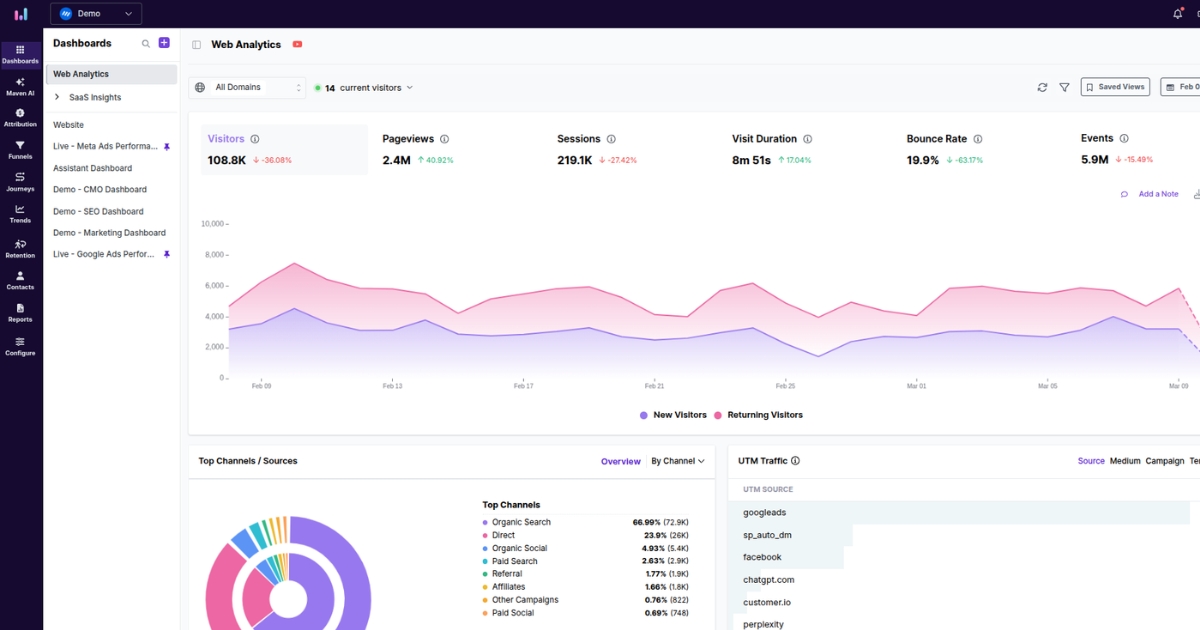
Usermaven is a leading attribution platform that helps teams understand how people move from first visit to conversion. It brings together website and product analytics, making it easier to follow the actions users take across the journey.
You can see where people engage, where they return, where they lose momentum, and which steps lead to action. That gives teams a stronger read on behavior across the full journey, not just at the point of conversion.
Features that support user behavior analysis include:
- Website analytics to understand page engagement, content interest, and conversion behavior.
- Product analytics to track feature usage, in-app actions, and drop-off points.
- Automatic event tracking to capture meaningful user actions without manual setup.
- Real-time dashboards to watch behavior patterns as they develop.
- Funnels to see where users continue and where they leave.
- User journeys to map the steps users take before converting.
- Segments to group users by behavior, source, stage, or intent.
- Multi-touch attribution software to connect user behavior across every stage of the journey.
- Conversion path analysis to reveal how users progress through the site or product on their way to conversion.
- Cohort analysis to compare behavior and retention across different groups.
Wrapping up
User behavior is where assumptions end. It reveals where curiosity turns into intent, where friction slows people down, and where momentum starts to build or fall apart. The real advantage comes from reading those signals early enough to improve the experience before the opportunity is lost.
Usermaven helps turn those signals into action. As a powerful marketing attribution platform, it connects user behavior to the full conversion path. That makes it easier to see which touchpoints are influencing decisions and where your marketing is creating real momentum.
See what your users are telling you before they convert. Start a free trial or book a demo with Usermaven today.
Leave a Reply