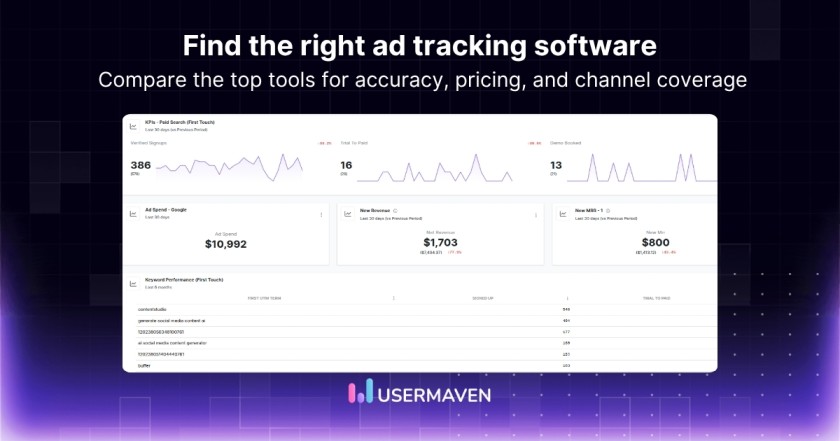
The ad tracking software market has never had more options. It has also never been harder to know which ones actually work.
Browser restrictions, iOS privacy changes, and ad-blocker growth have quietly broken the tracking setups most marketing teams built three years ago. The result is dashboards that look complete but miss 20 to 40 percent of actual conversions.
This guide compares the 11 best ad tracking software tools available in 2026, reviewed against the same criteria, so you can make a direct comparison. Whether you need an advanced ad tracking or an enterprise-grade attribution platform, every major option is covered here.
Key takeaways
- Ad tracking software connects ad spend to conversions and revenue across every paid channel from one independent measurement layer above individual platforms
- The best tools use first-party data and server-side tracking to maintain accuracy as third-party cookies disappear
- Usermaven leads for accuracy, privacy compliance, and multi-touch attribution at an accessible price point
- Pricing ranges from free (Google Ads native tracking) to over $2,000 per month for enterprise platforms
- Affordable ad tracking solutions like Usermaven and AttributionApp deliver near-complete accuracy without enterprise-level cost
- The right choice depends on channel mix, business model, and technical capacity — not the highest price tag
What is ad tracking software?
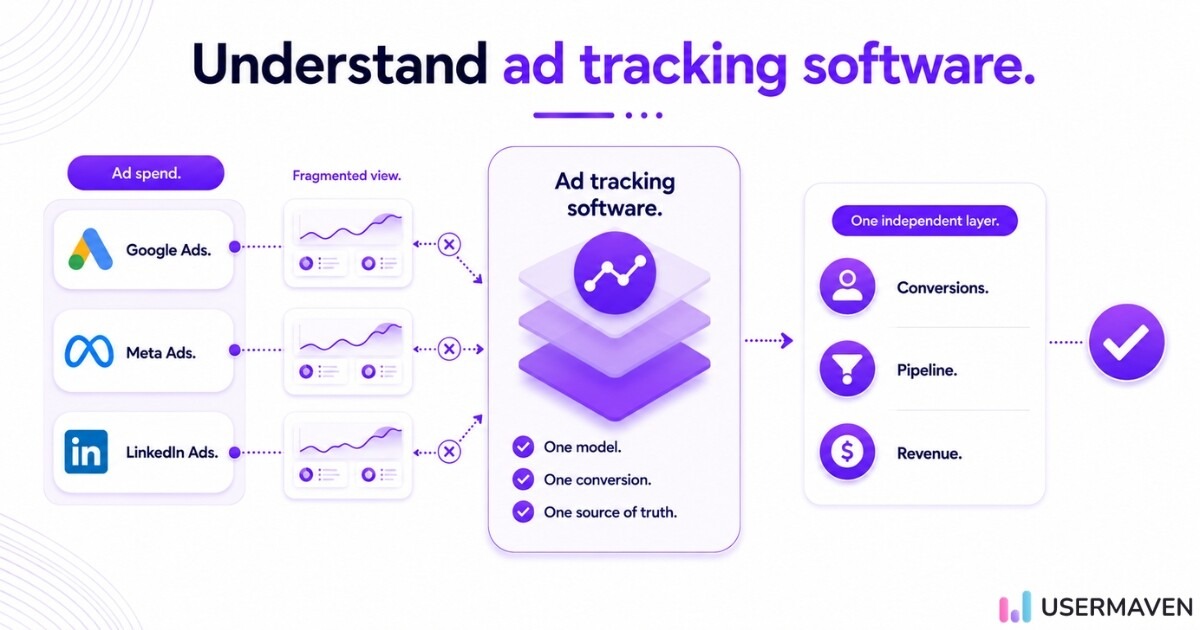
Ad tracking software is a platform that records how users interact with paid advertisements across channels and connects those interactions to conversions, pipeline, and revenue.
It replaces the fragmented view of individual platform dashboards with one independent measurement layer that applies consistent rules across every channel.
Without it, Google Ads, Meta, and LinkedIn each measure performance using their own attribution windows and identity rules. The result is structural double-counting where all three platforms claim the same conversion.
Ad tracking software applies one consistent model, counts each conversion once, and produces a number that reconciles with CRM and finance data. This is the core problem documented in the guide to ad platform discrepancies and why marketing attribution requires an independent layer above every platform.
11 best ad tracking software tools in 2026
Each tool below is reviewed against the same format, so you can compare directly. Criteria: tracking accuracy, channel coverage, ease of setup, pricing, and the specific use case each tool serves best.
1. Usermaven: Best overall ad tracking software
Overview
Usermaven is an AI-powered marketing attribution platform that connects ad platforms, CRM, and website data to track the full customer journey in real time using first-party and server-side tracking.
How it works
Usermaven places a lightweight first-party pixel on your website that bypasses most ad blockers. It collects session data and ties each visit to its originating campaign using UTM parameters and identity resolution.
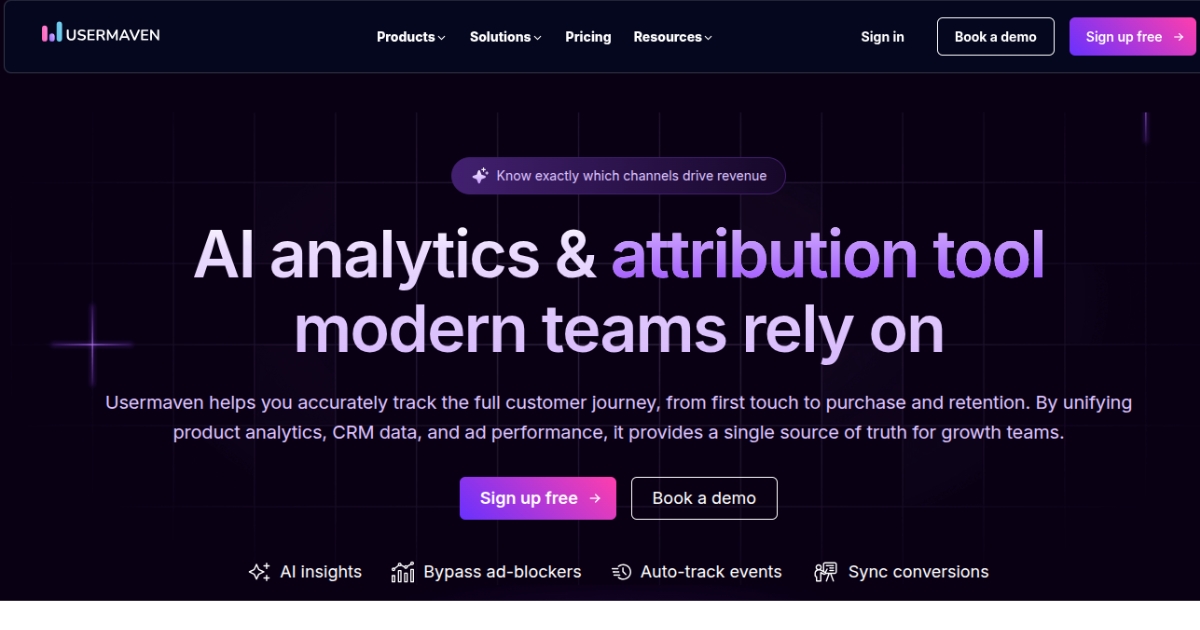
All channel data feeds into one attribution workspace. Teams see independent attribution across Google Ads, Meta, LinkedIn, and organic channels without relying on each platform’s self-reported numbers.
The website analytics software layer handles multi-domain tracking, while the marketing attribution software connects every paid touchpoint to revenue outcomes in one workspace.
Key highlights
- First-party pixel with ad-blocker bypass for near-complete data accuracy across all browsers and devices
- Seven attribution models, including first touch, last-click-attribution, linear, time decay,position-based, data-driven, and custom rules
- Maven AI surfaces which campaigns to scale or pause without manual analysis
- No-code setup in minutes with native integrations for Google Ads, Meta, LinkedIn, Shopify, and more
- Multi-domain tracking for teams and agencies managing multiple properties
- GDPR and CCPA compliant, with cookieless tracking built in by default
Pricing
Starts at $84/month for 250K events.
Ideal for
Marketing and product teams of all sizes that need accurate, unified ad tracking without enterprise-level cost or developer dependency.
2. Cometly: Best for first-party paid acquisition tracking
Overview
Cometly helps you see where your sales come from by connecting your ads, customer info, and website activity into one clear, real‑time view of the customer journey.
How it works
Cometly uses a first-party pixel alongside server-side Conversions API connections to capture conversion data that browser-only tools miss. It ties every click, lead, and sale back to the specific ad that drove it
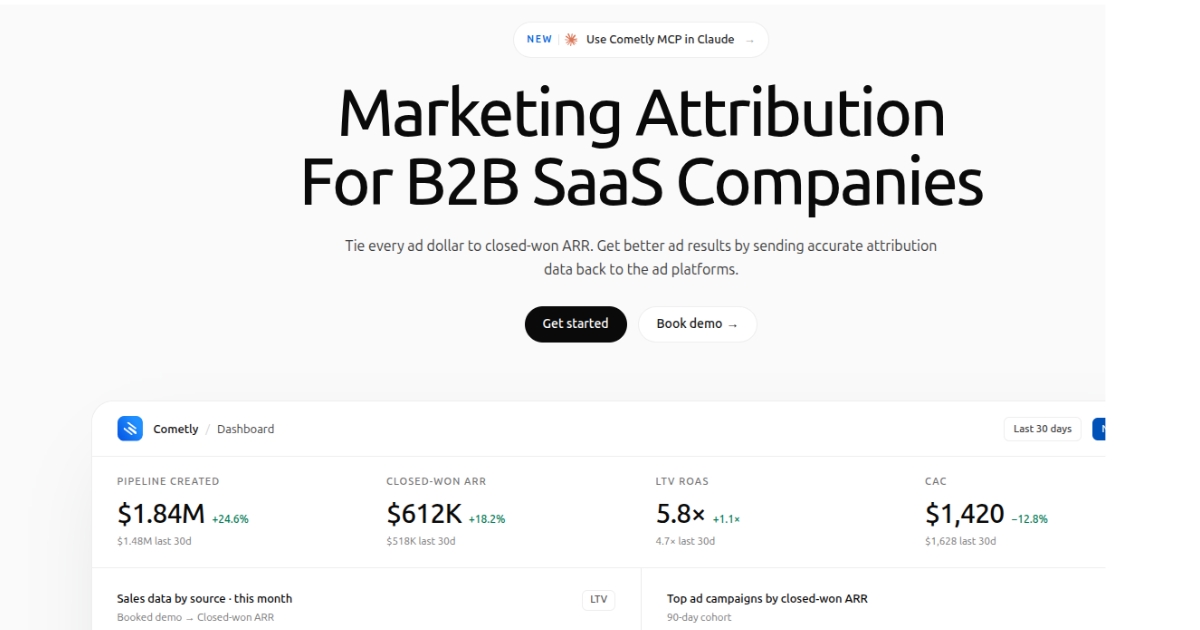
That data syncs back to Meta and Google for smarter automated bidding, creating a feedback loop between tracking accuracy and campaign optimisation.
Key highlights
- Server-side tracking that bypasses iOS 14.5 and ad-blocker limitations
- Real-time dashboard showing which ads generate revenue, not just clicks or cheap leads
- CRM and warehouse sync for full-funnel revenue attribution
- Multi-account management for agency clients without redundant setup
Pricing
Contact for pricing.
Ideal for
Performance marketers and agencies running paid acquisition who need first-party, ad-level attribution accuracy with CRM-connected revenue data. See Cometly alternatives if you want to compare similar first-party tracking tools
3. Triple Whale: Best for e-commerce and DTC brands
Overview
Triple Whale is a pixel-based attribution platform built specifically for Shopify-based DTC and ecommerce brands running high-frequency paid social campaigns.
How it works
A pixel placed on Shopify stores collects cross-channel behavior and feeds dashboards showing performance by channel, creative, and audience. The built-in data warehouse stores historical data for seasonal comparisons and trend analysis.

Key highlights
- AI features surface, which campaigns acquire new customers at a healthy cost
- Tracks social and search spend against repeat purchases, not just first orders
- Strong integrations with Shopify, Meta, and TikTok
- Built-in data warehouse for historical comparisons
Pricing
Starts at $199/month.
Ideal for
E-commerce and DTC brands running high-frequency paid social acquisition on Meta and TikTok with Shopify as their primary store platform.
4. Hyros: Best for high-spend advertisers and course creators
Overview
Hyros is an AI-powered ad tracking platform built for high-spend advertisers, course creators, coaches, and info-product businesses running complex multi-step funnels.
How it works
Hyros uses a combination of first-party tracking and email-based identity resolution to attribute conversions across long, multi-touch customer journeys. It is particularly strong at tracking conversions that happen days or weeks after the initial ad click, where standard 7-day attribution windows miss them entirely.
Key highlights
- Email-based identity resolution for cross-device and cross-browser tracking
- Long attribution window suited to high-consideration purchases and multi-step funnels
- AI-powered ROAS modeling and revenue forecasting
- Integrates with Google Ads, Meta, and major email platforms
Pricing
Starts at approximately $100/month, depending on ad spend tier.
Ideal for
High-spend advertisers, coaches, and course creators where standard attribution windows undercount conversions from long consideration paths.
5. RedTrack: Best for performance marketers and affiliate tracking
Overview
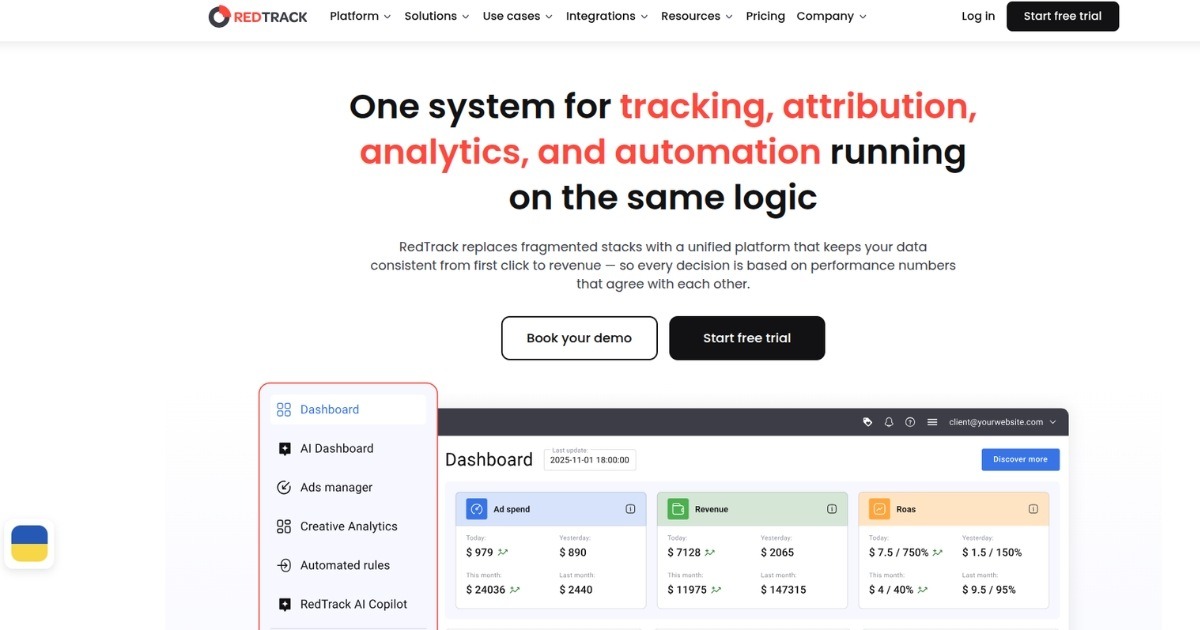
RedTrack is a performance marketing tracker built for media buyers, affiliates, and performance agencies that need granular click-level tracking across many paid channels simultaneously.
How it works
RedTrack uses redirect and postback tracking to monitor every click, impression, and conversion at the campaign, ad set, and creative level. It works with any traffic source and integrates directly with major ad networks through API connections.
Key highlights
- Granular click-level tracking across unlimited traffic sources
- Postback URL integration for server-to-server conversion tracking
- Built-in A/B testing and campaign optimisation automation rules
- Strong affiliate and media buying workflow features
Pricing
Starts at $149/month.
Ideal for
Performance marketers, media buyers, and affiliate teams that need granular click tracking across many traffic sources and complex multi-offer campaigns.
6. Northbeam: Best for high-volume paid social agencies
Overview
Northbeam is a multi-touch attribution platform with predictive analytics built for performance media buyers making daily optimisation decisions across large budgets.
How it works
Northbeam combines multi-touch attribution with predictive spend modeling that estimates how budget changes might affect revenue in the coming days. Real-time data refresh cycles give media buyers fast feedback on creative and audience performance without waiting for overnight data pulls.
Key highlights
- Real-time data refresh suited to agencies managing large daily budgets
- Predictive models estimating the revenue impact of budget shifts across channels
- Strong Meta and TikTok focus for growth-stage consumer brands
- Cross-device and cross-platform path tracking
Pricing
Contact for pricing.
Ideal for
Performance agencies managing aggressive paid social budgets where fast, actionable media buying decisions directly drive client results.
7. Ruler Analytics: Best for offline and online ad tracking
Overview
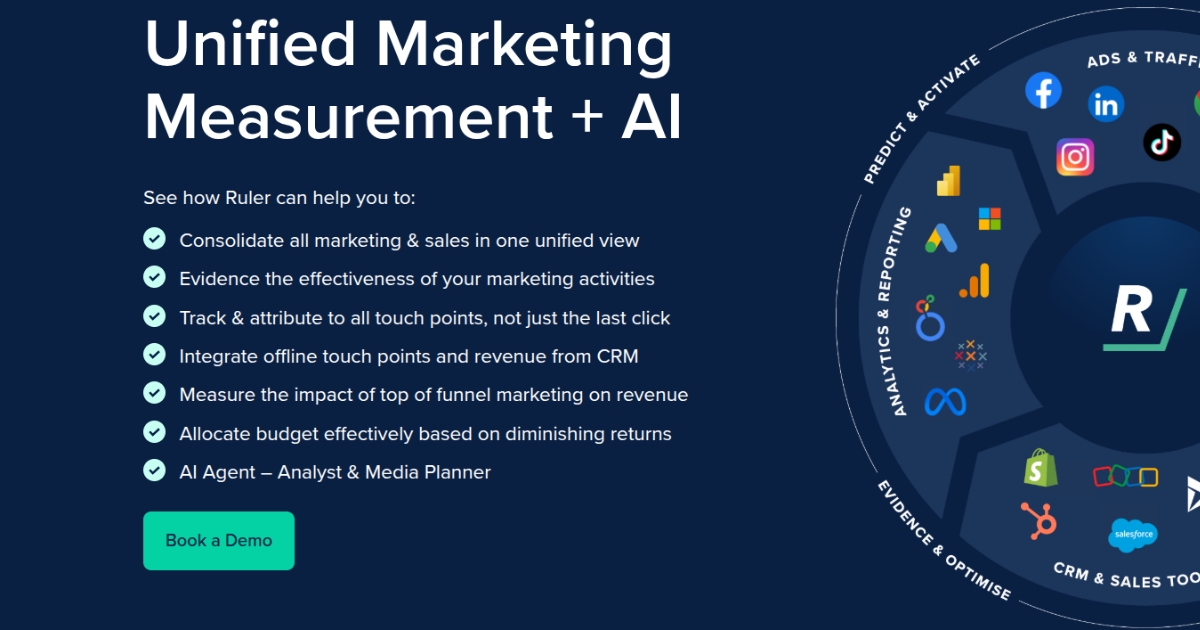
Ruler Analytics connects online marketing activity with offline conversion data, making it the strongest option for businesses where phone calls and in-person visits are primary revenue drivers.
How it works
Ruler links website behavior, form fills, and call tracking data with CRM records, then passes verified revenue back to ad platforms for more accurate bid optimization. Each marketing source gets credit based on the actual revenue it drove, not just the lead it generated.
Key highlights
- Offline phone call tracking alongside digital touchpoints
- Closed-loop revenue reporting down to the keyword and campaign level
- Pipeline visibility tied directly to marketing activity
- Supports first touch, last touch, linear, time decay, and full path models
Pricing
The plan starts at approximately 400$ per month.
Ideal for
B2B services, healthcare, and professional service businesses where phone calls, consultations, or in-person visits drive significant conversion volume alongside digital campaigns.
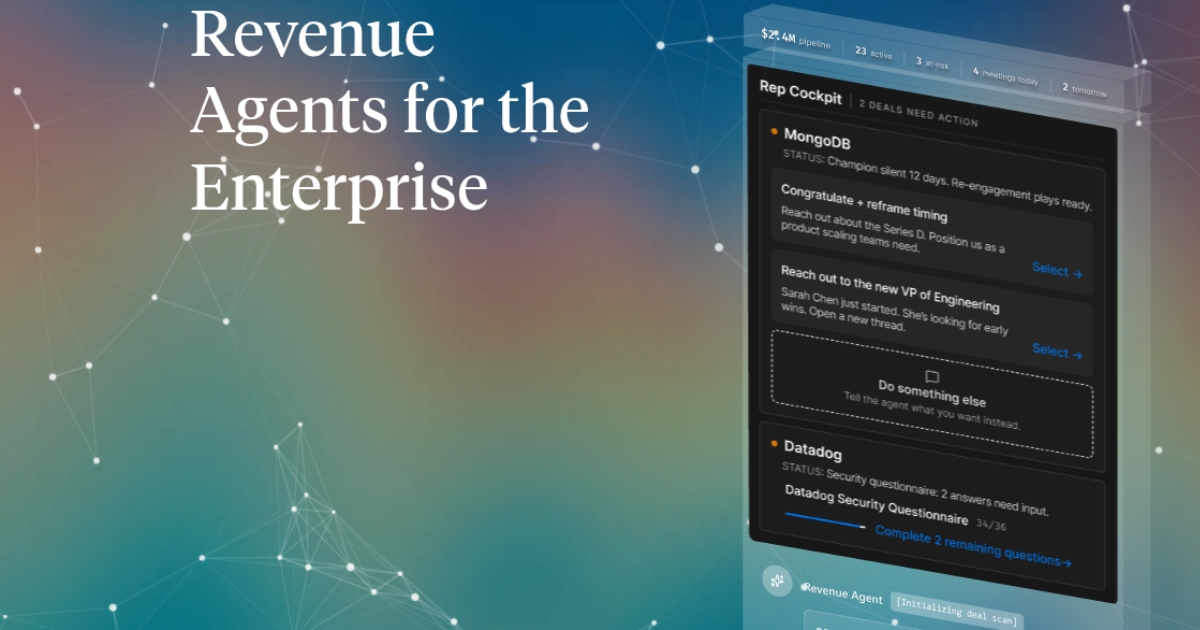
8. HockeyStack: Best for enterprise B2B ad tracking
Overview
HockeyStack is a revenue attribution platform built for enterprise B2B teams managing complex multi-stakeholder buying cycles and large deal values.
How it works
HockeyStack tracks full-funnel paths from the first anonymous visit through the marketing qualified contact, opportunity stage, and closed revenue. Deep CRM integration lets it attribute pipeline and bookings to specific campaigns, channels, and individual content pieces.
Key highlights
- Account-level reporting for B2B environments where buying decisions involve several stakeholders
- Visibility into how webinars, LinkedIn posts, and events influenced the pipeline and deals
- Justifies upper-funnel spend beyond last-click logic for complex buying groups
For a deeper look at this approach, see the guide to B2B marketing attribution.
Pricing
Starts at approximately $2,200/month for approximately 30,000 visitors.
Ideal for
Enterprise B2B teams presenting attribution data to CMOs and revenue operations leaders who need deep account paths and multi-stakeholder journey visibility. You can further explore HockeyStack alternatives for a comparison of similar enterprise B2B attribution platforms.
9. AttributionApp: Best affordable ad tracking solution
Overview
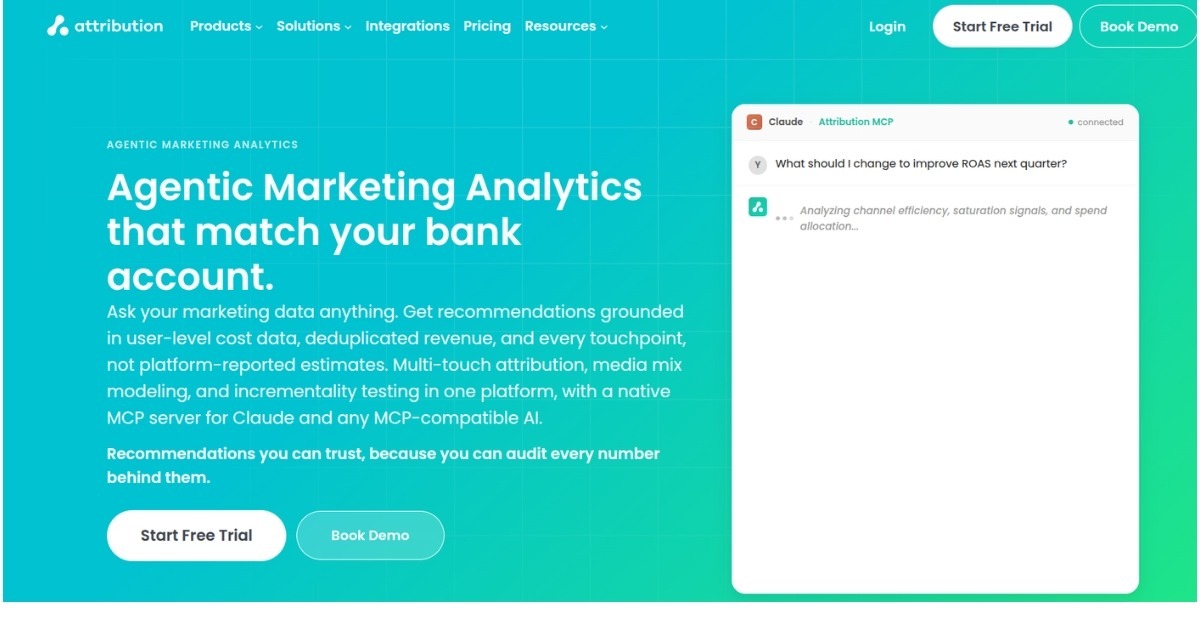
AttributionApp is a user-level cost tracking platform that connects actual ad spend to individual user journeys across multiple paid channels at the most accessible price point on this list.
How it works
AttributionApp pulls real spend from ad platform APIs and links that cost to each user path rather than relying on UTM estimates or platform-reported conversions. This produces per-user CAC and ROAS figures that align with finance data rather than optimistic platform claims.
Key highlights
- Configurable multi-touch models with full data transparency on every metric
- Raw data exports to BigQuery, Snowflake, and Redshift for custom analysis
- Marketing mix modeling and incrementality tests are included at this price tier
Pricing
E-commerce plans start at $19/month for Shopify and BigCommerce brands. Other plans start at $399/month.
Ideal for
Cost-conscious teams that need accurate multi-channel attribution and data warehouse access without enterprise-level pricing.
10. Google Ads conversion tracking: best for Google-only campaigns
Overview
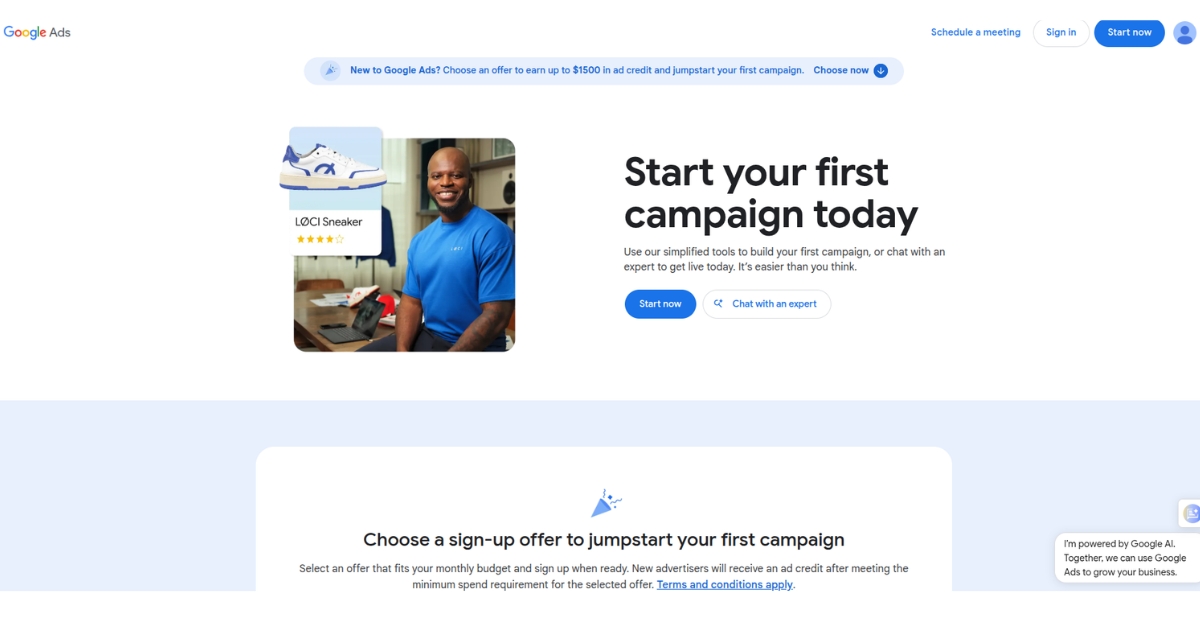
Google Ads conversion tracking is the native measurement tool built directly into the Google Ads platform, using the Google Tag to connect ad clicks to website conversions.
How it works
The Google tag fires on conversion pages and connects those events to the originating ad click using the GCLID parameter. Smart Bidding strategies use this conversion data to automatically optimize bids toward campaigns that generate results.
Key highlights
- Native integration with Google Ads, Google Analytics, and Google Tag Manager
- Connects directly to Smart Bidding for automated bid optimisation
- Cross-device tracking for signed-in Google users through Google Signals
- No additional cost beyond any existing Google Ads account
Pricing
Free with any Google Ads account.
Ideal for
Teams running primarily Google Ads campaigns who want tight ecosystem integration and are comfortable with Google’s data modeling limitations for privacy-opted-out users.
11. Rockerbox: Best for omnichannel brands combining digital and brand spend
Overview
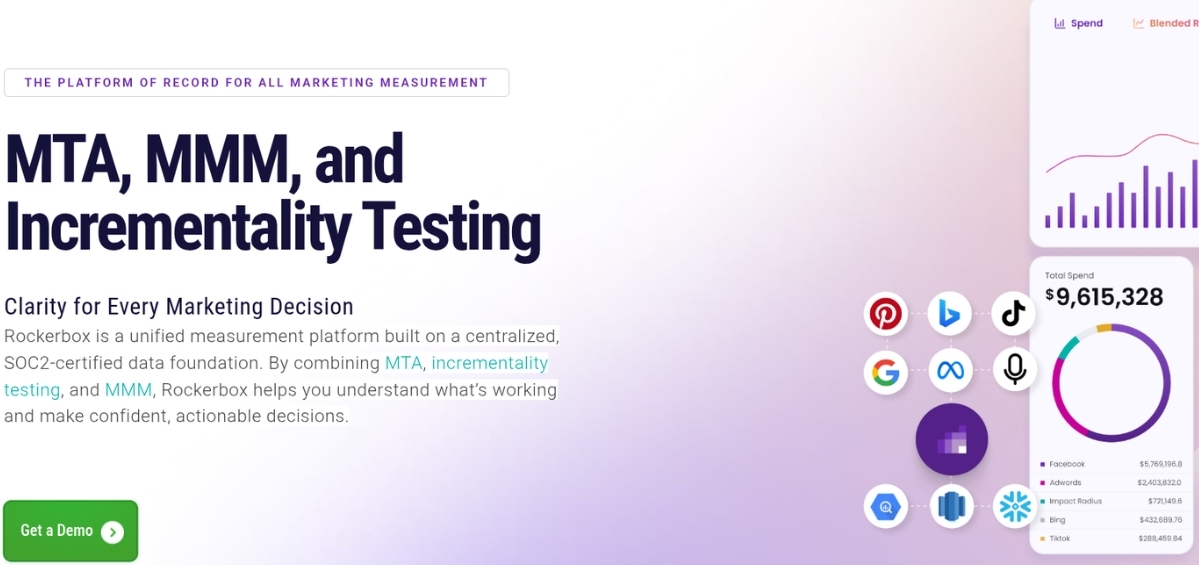
Rockerbox is a marketing measurement platform that combines multi-touch attribution, marketing mix modeling, and incrementality testing into one unified layer for brands running both performance digital and upper-funnel brand campaigns.
How it works
Rockerbox centralises data from paid search, paid social, display, connected TV, OTT, affiliate, programmatic, and direct mail into one measurement layer. It applies consistent attribution logic across all channels so teams can answer both campaign-level and channel-mix questions from the same platform without stitching together separate tools.
Key highlights
- Combines MTA, marketing mix modeling, and incrementality testing in one platform
- Covers 100-plus integrations including Google, Meta, TikTok, Pinterest, Snapchat, and Reddit
- Answers both micro questions about specific campaigns and macro questions about overall channel mix
- Eliminates the need for separate tools across digital and offline measurement
Pricing
Contact for pricing.
Ideal for
Mid-to-large brands and agencies managing omnichannel clients that want one place to evaluate digital performance and brand spend together. For a combined MTA and MMM approach, see multi-touch attribution vs marketing mix modeling.”
Ad tracking software comparison table
Use this ad tracking software comparison to shortlist before committing time to demos and trials. Every agency has a different channel mix, sales cycle, and reporting requirement.
For a broader context on how these tools perform across user reviews, the G2 ad tracking software category compiles verified user ratings across all major platforms. According to Statista’s global advertising forecast, total ad spending is expected to reach $1.26 trillion by 2026, with digital channels accounting for an increasingly dominant share of the market.
| Tool | Best for | Attribution models | Starting price | First-party tracking |
|---|---|---|---|---|
| Usermaven | All teams | 7 models incl. AI | $84/month | Yes |
| Cometly | Paid acquisition | First-party MTA | Custom pricing | Yes |
| Triple Whale | E-commerce/DTC brands | Multi-touch | $199/month | Partial |
| Hyros | High-spend advertisers | AI-powered MTA | ~$100/month | Yes |
| RedTrack | Performance/affiliate | Multi-touch | $149/month | Partial |
| Northbeam | High-volume paid teams | Predictive MTA | Custom pricing | Partial |
| Ruler Analytics | Offline and online | 5 models | ~$400/month | Partial |
| HockeyStack | Enterprise B2B | Account-level | ~$2,200/month | Partial |
| AttributionApp | Cost-conscious teams | 5 attribution models | $19/month (ecommerce) | Partial |
| Google Ads | Google-only campaigns | Last-click (default) | Free | No |
| Rockerbox | Omnichannel brands | MTA + MMM | Contact for pricing | Partial |
[insight_growth]
How to choose the right ad tracking software
The right ad tracking platform comparison starts with your own client base and channel mix, not the feature list of the most expensive tool. Here is a practical framework by business type.
E-commerce and DTC brands
Short conversion cycles, Shopify stack, high Meta and TikTok spend. Triple Whale for e-commerce-native attribution. Usermaven for teams that also need organic, email, and product analytics alongside paid tracking in one place.
B2B and SaaS companies
Long sales cycles, CRM-driven attribution, and account-level reporting. HockeyStack for enterprise deal values. Usermaven for growth-stage teams needing accurate attribution without enterprise cost or developer dependency. See the full guide to attribution software for agencies for multi-client setups.
High-spend advertisers and course creators
Long consideration windows, multi-step funnels, and email-based journeys. Hyros for deep identity resolution across conversion paths that span weeks. Usermaven for teams that also need website and product analytics alongside paid channel attribution.
Performance agencies and media buyers
Granular click tracking, multi-source coverage, multi-client management. RedTrack for media buying and affiliate tracking. Cometly for paid acquisition with CRM sync. Usermaven for agencies needing multi-client workspaces and white-label capability.
Small teams and startups
Fast setup, accessible pricing, no developer required. Usermaven at $84/month covers the most common tracking needs with accurate cross-channel marketing attribution at a fraction of enterprise platform pricing.
Whichever tool you choose, moving away from last-click attribution and platform-reported numbers produces a clearer picture of which channels actually drive revenue. The guide to multi-touch attribution explains how to apply the right model for each campaign type.
What to look for in ad tracking software
[IMAGE 1200x630px via Canva] Alt: Checklist of key criteria for evaluating ad tracking software tools including accuracy privacy compliance and integration depth
Not all ad tracking tools work the same way. Evaluating them against these criteria before committing to a trial saves significant time and budget.
Tracking accuracy and data completeness
Tools relying solely on browser pixels lose a significant portion of conversions in privacy browsers and ad-blocker environments. Look for server-side tracking, first-party data collection, and ad-blocker bypass technology as baseline requirements.
Attribution model flexibility
Look for tools offering multiple marketing attribution models: first touch, last touch, linear, time decay, position-based, and data-driven . Switching models per campaign reveals which channels introduce, nurture, and close customers rather than forcing one view for every account.
Multi-channel coverage
Your ad tracking analytics tool should cover Google Ads, Meta, LinkedIn, TikTok, Pinterest, email, and organic in one view. Gaps in channel coverage push teams back to individual platform dashboards for every reporting cycle.
Privacy compliance
GDPR and CCPA compliance is a legal requirement for brands serving users in Europe or California. Look for cookieless tracking and consent management integration built in by default, not added as a paid upgrade.
Integration depth
Verify native, maintained connections to your CRM, ecommerce platform, and ad accounts. Shallow integrations break silently and create gaps that teams rarely notice until a quarterly business review.
Pricing scalability
Tools start from $84 per month. Enterprise platforms reach $2,200 per month and above. Match the tool cost to the revenue it protects rather than assuming the highest price produces the most accurate data.
Ease of setup and maintenance
No-code setup tools reduce the time from contract to clean data. Tools requiring developer involvement tend to drift out of sync during busy campaign periods when the team has no capacity for technical maintenance.
Conclusion
The right ad tracking software is not the most expensive one on this list. It is the one that captures your conversions accurately, works within your budget, and integrates with the channels and tools your team already uses.
Bad tracking does not just produce bad reports. It produces bad budget decisions.
Every platform claims more credit than it deserves. Independent tracking gives you one number you can actually trust.
The gap between what platforms report and what your CRM records is exactly where ad spend gets wasted. For a broader view of how ad tracking fits inside your overall marketing analytics setup, see how unified data changes every decision your team makes.
Not sure where to start? Usermaven’s guided analytics setup walks you through connecting your ad platforms and eliminating tracking gaps in one structured process.
You can book a free demo to see how accurate attribution changes the numbers your team reports.
[fix_whats_not]
FAQs
1. What is the best ad tracking software in 2026?
2. What is the most affordable ad tracking solution?
3. What is the difference between ad tracking software and native platform tracking?
See Google Analytics limitations and GA4 ad blocker for specific examples of how native tracking underperforms.
4. Which ad tracking software works best for privacy compliance?
Tools still relying primarily on third-party cookies are declining in accuracy as browser restrictions increase. See privacy-first analytics tools for a full breakdown of what privacy compliance means for tracking accuracy.
5. Can ad tracking software fix cross-platform discrepancies?
This eliminates the structural double-counting that makes Google, Meta, and LinkedIn all claim the same sale.