Every marketing campaign produces data, but data alone doesn’t tell you what actually worked. A campaign might attract thousands of visitors and still fail to generate meaningful results if the right insights aren’t uncovered.
This is why campaign analytics plays such an important role in modern marketing. It helps teams look beyond surface-level numbers and understand how people truly interact with their campaigns.
By analyzing user behavior across different channels, marketers can identify what captures attention, what drives engagement, and what ultimately leads to conversions. These insights make it easier to refine messaging, improve targeting, and allocate budgets more strategically.
When used effectively, campaign analytics helps marketers turn everyday campaign data into valuable insights that guide smarter marketing decisions.
What is campaign analytics?
Campaign analytics is the process of tracking, measuring, and analyzing the performance of marketing campaigns.
Every campaign generates data such as clicks, impressions, conversions, engagement, and revenue. Campaign analytics helps marketers interpret this data to understand what is working and what needs improvement.
Instead of launching campaigns and hoping for results, analytics helps teams answer questions like:
- Which marketing channels drive the most conversions?
- Which campaigns attract high-quality leads?
- Which messages resonate most with audiences?
- How does campaign performance change over time?
Analyzing these patterns helps marketers generate campaign performance insights that improve future campaigns.
Campaign analytics also supports marketing performance analysis, which evaluates how different marketing initiatives contribute to broader business goals such as revenue growth or customer acquisition.
Without campaign analytics, marketing decisions often rely on assumptions. With it, marketers can rely on real performance data to improve results and scale successful campaigns.
How campaign analytics works
Campaign analytics works by collecting data from different marketing channels and analyzing that information to understand how campaigns influence user behavior.
Every campaign typically includes several touchpoints. A user might:
- See a social media ad
- Click through to a landing page
- Read blog content
- Subscribe to an email list
- Convert later through a promotional email
Campaign analytics helps marketers connect these interactions and understand how the entire campaign contributes to conversions.
The process typically involves four main stages.
Stage 1: Data collection
The first step is gathering campaign data. This includes information from multiple sources such as paid ads, email marketing platforms, social media campaigns, and website analytics tools.
Tracking technologies like UTM parameters, event tracking, and attribution models help capture these interactions.
Stage 2: Campaign tracking
Once data is collected, campaign tracking identifies where users came from and which campaigns influenced their actions.
This is especially important for understanding cross-channel campaign performance, since most customers interact with multiple marketing touchpoints before converting.
Stage 3: Campaign performance analysis
After the data is collected, marketers analyze the results using campaign analytics dashboards and reporting tools.
This analysis helps marketers identify patterns such as:
- Which campaigns drive the highest engagement
- Which channels generate the most conversions
- Which campaigns produce the strongest return on investment
Stage 4: Insight generation
Finally, marketers translate data into actionable insights. These campaign performance insights help improve future campaigns, optimize budgets, and refine marketing strategies.
In other words, campaign analytics turns raw data into decisions.
Campaign analytics channels
Modern marketing campaigns rarely rely on a single channel. Businesses typically promote campaigns across multiple platforms, each with its own audience behavior and performance patterns.
Campaign analytics helps marketers evaluate how campaigns perform across these different channels and understand how each contributes to overall marketing success.
Below are some of the most common types of marketing campaign analytics.
Email campaign analytics
Email remains one of the most effective marketing channels for nurturing leads and driving conversions. Because email interactions are easy to track, email campaign analytics provides valuable insights into audience behavior.
Typical email campaign analytics metrics include:
- Open rate
- Click-through rate
- Conversion rate
- Unsubscribe rate
- Revenue generated from email campaigns
By analyzing these metrics, marketers can identify which email subject lines, offers, and zero party data strategies resonate most with subscribers.
Social media campaign analytics
Social media campaigns often focus on engagement and brand awareness, making social media campaign analytics slightly different from other channels.
Common social campaign metrics include:
- Impressions
- Engagement rate
- Comments and shares
- Link clicks
- Follower growth
Social media campaign analytics helps marketers understand which content formats perform best and which platforms deliver the strongest engagement.
Paid campaign analytics
Paid advertising campaigns are highly measurable, which makes paid campaign analytics essential for optimizing ad budgets.
Key paid campaign metrics include:
- Cost per click (CPC)
- Cost per acquisition (CPA)
- Return on ad spend (ROAS)
- Conversion rate
Paid campaign analytics allows marketers to evaluate whether advertising investments are producing profitable results.
If a campaign generates strong traffic but low conversions, marketers can adjust targeting, creative messaging, or landing pages to improve results.
Content campaign analytics
Content marketing campaigns aim to attract and educate audiences through blogs, videos, guides, and other educational resources.
Because content campaigns often generate results over a longer period, content campaign analytics focuses on metrics such as:
- Organic traffic
- Page engagement
- Lead generation
- Assisted conversions
Content analytics helps marketers understand which content topics drive traffic and how content contributes to the overall marketing funnel. Many teams also leverage web scraping to monitor competitor content performance, track search trends, and gather publicly available market data at scale.
[user_journeys]
Key campaign analytics metrics to track
Tracking the right campaign analytics metrics is essential for understanding how campaigns perform and where improvements can be made.
Most marketing teams focus on three main categories of metrics.
Acquisition metrics
Acquisition metrics measure how effectively campaigns attract new users or potential customers.
Important acquisition metrics include:
- Click-through rate (CTR)
- Cost per click (CPC)
- Cost per acquisition (CPA)
- Conversion rate
These metrics reveal how efficiently campaigns bring visitors to your website or landing pages.
If acquisition metrics are weak, it may indicate that the campaign targeting or messaging needs improvement.
Engagement metrics
Once users arrive, engagement metrics help marketers understand how visitors interact with the content.
Common engagement metrics include:
- Bounce rate
- Average session duration
- Page views
- Social engagement
High engagement usually signals that campaign messaging aligns well with audience expectations.
Revenue metrics
Ultimately, most campaigns aim to generate revenue.
Revenue-focused metrics help marketers connect campaigns to business results.
Examples include:
- Return on ad spend (ROAS)
- Customer lifetime value (CLV)
- Average order value (AOV)
- Attributed revenue
By analyzing revenue metrics, marketers can determine which campaigns generate the most value.
A step-by-step guide to campaign analysis
Once campaign tracking is in place, marketers can perform campaign performance analysis to evaluate results and optimize strategies.
Campaign analysis usually follows a structured process.
Step 1: Define campaign objectives
Every campaign should begin with clear goals.
These objectives determine which campaign analytics metrics should be tracked.
For example:
- A lead generation campaign focuses on form submissions
- A product campaign focuses on purchases
- A brand awareness campaign focuses on reach and engagement
Clearly defined goals ensure that campaign analytics focuses on meaningful outcomes.
Step 2: Implement campaign tracking
Campaign tracking ensures that every interaction can be measured.
This typically involves:
- Adding UTM parameters to campaign links
- Implementing event tracking on websites
- Setting up conversion tracking
- Configuring attribution models
Proper tracking creates the foundation for accurate campaign analytics.
Step 3: Analyze campaign performance
After collecting data, marketers begin analyzing campaign results.
Campaign performance analysis helps identify:
- Which channels generate the highest conversions
- Which campaigns attract high-quality traffic
- Where users drop off in the conversion funnel
These insights help marketers improve targeting, messaging, and channel strategy.
Step 4: Optimize campaigns
Campaign analytics is not just about reporting results. It is about improving future campaigns.
Marketers often test different variations of:
- Ad creatives
- Landing pages
- Audience targeting
- Campaign messaging
Over time, this optimization process leads to stronger campaign performance and higher ROI.
Campaign analytics use cases
Campaign analytics isn’t only useful for measuring results after a campaign ends. It plays a critical role throughout the marketing lifecycle, helping teams plan, evaluate, and optimize campaigns more effectively.
Different marketing teams use campaign analytics in different ways depending on their goals. Below are some of the most common use cases where campaign analytics delivers the most value.
Understanding the customer journey
Customers rarely convert after a single interaction. They usually interact with multiple marketing touchpoints before making a decision.
Campaign analytics helps marketers analyze the entire customer journey, identifying which interactions influence conversions the most.
For example, a typical customer journey might look like this:
- Discover a blog post through search
- Subscribe to an email newsletter
- Click a promotional email
- Return to the website and convert
Campaign analytics reveals how these touchpoints connect and which campaigns play the biggest role in moving customers through the funnel.
Identifying high-performing campaigns
Another important use case for campaign analytics is identifying top-performing campaigns.
By analyzing campaign data, marketers can uncover patterns such as:
- Which campaigns generate the highest conversion rates
- Which messaging resonates most with audiences
- Which campaigns attract high-quality leads
These insights allow marketers to replicate successful campaigns and avoid repeating ineffective strategies.
Campaign analytics tools
Marketing campaigns generate large amounts of data across different platforms, making manual analysis difficult. Campaign analytics tools help marketers track performance, analyze data, and generate insights more efficiently.
Below are some commonly used campaign analytics tools.
1. Usermaven
Usermaven is an advanced attribution and analytics software designed to help businesses track and analyze marketing campaigns without complicated setups. It provides clear marketing campaign attribution, allowing teams to understand which channels and touchpoints contribute most to conversions and revenue.
It allows marketing teams to:
- Track campaign performance across channels
- Analyze user behavior and conversion paths
- Monitor campaign analytics metrics in real time
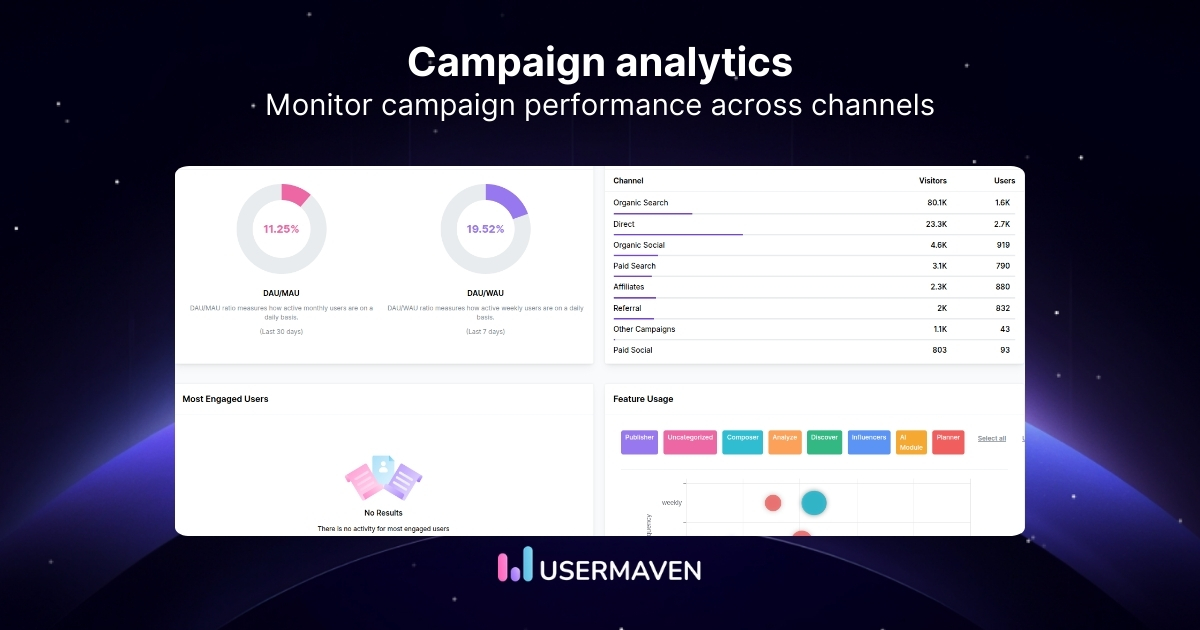
- Visualize marketing performance through intuitive dashboards
Because it automatically captures events and user interactions, Usermaven simplifies campaign analytics and helps marketers gain clear insights into campaign performance.
[user_journeys]
2. Google Analytics
Google Analytics is widely used for tracking website traffic and marketing campaigns. It allows marketers to measure campaign performance through traffic reports, conversions, and user behavior analysis.
However, its setup can be complex and requires careful configuration to track campaigns accurately.
3. HubSpot
HubSpot provides marketing automation and analytics tools that help businesses measure campaign performance across marketing channels.
It offers reporting features for email campaigns, paid ads, and lead generation campaigns.
4. Mixpanel
Mixpanel focuses on product and behavioral analytics. It helps teams analyze user interactions and measure how campaigns influence product engagement.
5. Adobe Analytics
Adobe Analytics is an enterprise-level analytics platform designed for large organizations that need advanced data analysis and reporting capabilities.
Choosing the right campaign analytics tool depends on the size of your business, the complexity of your campaigns, and the insights you want to generate.
Best practices for campaign analytics
To get the most value from campaign analytics, marketing teams should follow several best practices. These practices help ensure accurate data collection and meaningful insights.
- Establish clear campaign goals: Every campaign should start with a defined objective. Clear goals help determine which metrics matter and make it easier to measure success.
- Use consistent campaign tracking: Consistent tracking ensures campaign data is reliable and comparable. This typically includes standardized naming conventions, UTM parameters, and event tracking.
- Monitor campaign performance regularly: Campaign analytics should be reviewed throughout the campaign, not just at the end. Regular monitoring helps identify issues early and optimize performance.
- Focus on meaningful metrics: Prioritize metrics that reflect real business outcomes, such as conversions, revenue, and customer acquisition, rather than vanity metrics.
To sum it up!
Campaign analytics helps marketers understand how marketing campaigns perform across channels, audiences, and customer journeys. By tracking campaign analytics metrics and analyzing campaign data, businesses can identify opportunities to improve campaign performance and generate better marketing results.
Usermaven simplifies campaign analytics by providing a powerful website analytics tool that tracks campaign performance, attribution, and user behavior in one place. With a unified campaign analytics dashboard, marketing teams can analyze marketing campaign analytics more efficiently and uncover deeper campaign performance insights.
Want to see how your campaigns actually perform? Start a free trial or book a demo today and explore how Usermaven can help you track results, identify opportunities, and improve your marketing strategies.
FAQs
1. Why is campaign analytics crucial for your business?
2. What challenges do marketers face with campaign analytics?
3. What campaign analytics trends should marketers watch in 2026?
4. What are the benefits of campaign analytics?
It also provides clearer visibility into performance across channels, making it easier to identify opportunities for improvement and maximize marketing ROI.