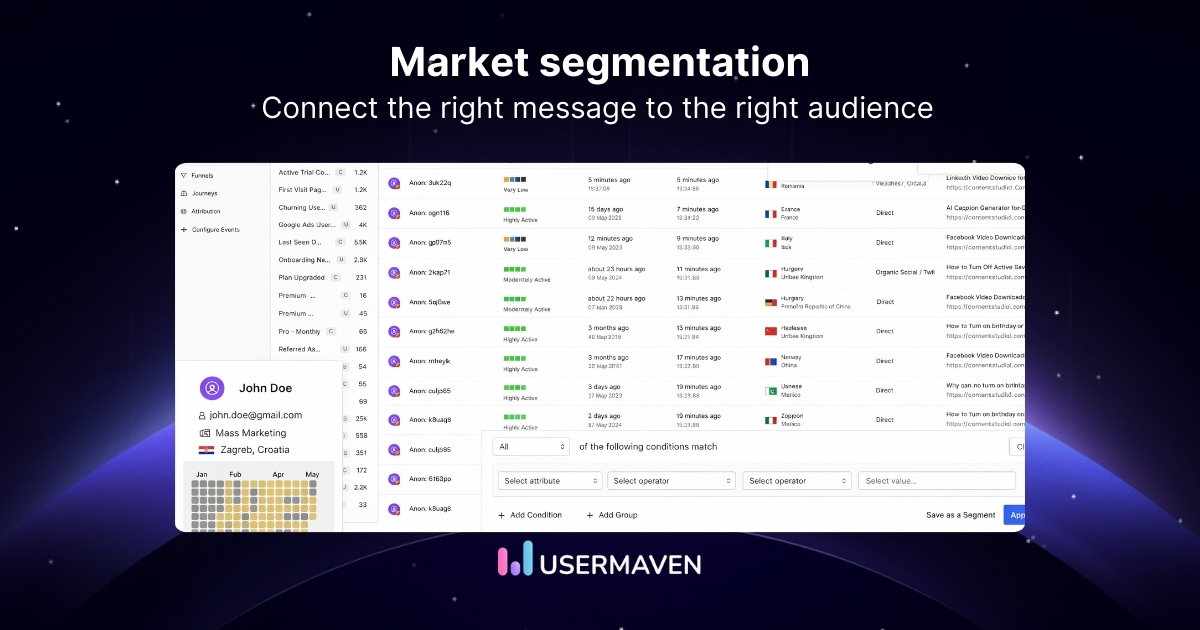
80% of people are more likely to buy from brands that personalize their experience. Yet many businesses still market to everyone in the same way.
That is where market segmentation analysis comes in.
Instead of guessing what your audience wants, it helps you divide your customers into clear groups based on user behavior, needs, or interests. This makes it easier to send the right message to the right people and get better results from your marketing.
What is market segmentation analysis?
Market segmentation analysis is the process of dividing your audience into smaller groups and studying their behavior, needs, and preferences to understand how to market to them effectively.
In simple terms, it helps you figure out who your customers are, what they want, and how to reach them with the right message.
While market segmentation focuses on grouping customers, segmentation analysis goes a step further. It looks at patterns in data such as user behavior, purchase activity, and engagement to find meaningful insights.
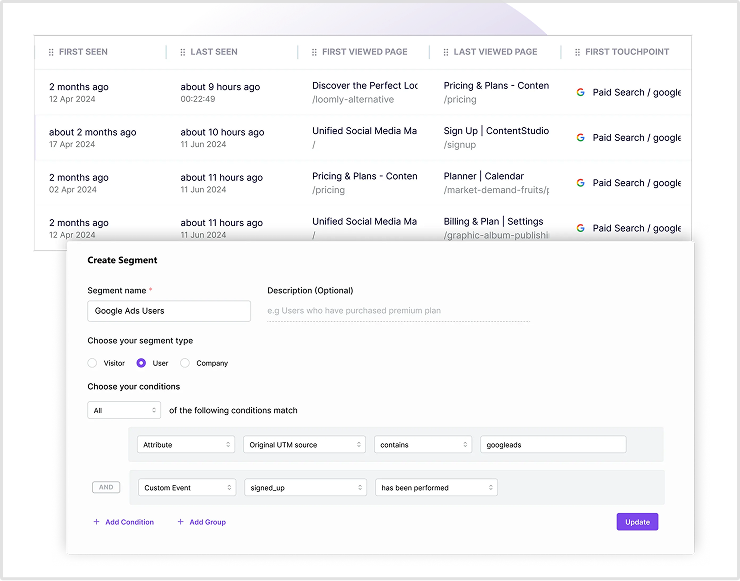
This makes segmentation analysis in marketing more useful because it is not just about creating groups. It is about understanding how each group behaves and how you can tailor your market segmentation strategy for better results.
Importance of market segmentation
Not all customers are the same. Market segmentation analysis helps businesses understand and act on these differences:
- Some customers prefer advanced features, while others want simplicity
- It helps customise messaging based on customer needs and expectations
- Improves onboarding and user experience across different customer groups
- Prevents overwhelming users with irrelevant information
- Helps identify key segments like new users, loyal customers, or high-value buyers
- Makes it easier to personalize communication and marketing efforts
What are the different types of market segmentation?
Market segmentation helps you group your audience in different ways depending on what you want to learn. Each type focuses on a specific aspect of your customers.
Here are the most common types:
Demographic segmentation
Demographic segmentation is one of the simplest ways to segment your audience. It groups people based on basic characteristics.
- Age
- Gender
- Income
- Education
- Job role
For example, a company might offer different pricing plans for startups, mid-sized teams, and enterprises based on budget and needs.
👉 Best used when you want a quick way to define your target audience.
Geographic segmentation
Geographic segmentation types group customers based on where they are located.
- Country
- City or region
- Time zone
- Language
For example, a business may adjust messaging, pricing, or support based on location.
👉 Best used when location affects customer needs or behavior.
Psychographic segmentation
Psychographic segmentation focuses on how people think and what they care about.
- Interests
- Values
- Lifestyle
- Preferences
For example, some users may care more about simplicity, while others want advanced features and flexibility.
👉 Best used when you want to improve messaging and brand positioning.
Behavioral segmentation
Behavioral segmentation is one of the most powerful types because it is based on actual user actions.
- Product usage
- Feature adoption
- Purchase behavior
- Engagement level
For example, you can identify users who are highly active versus those who are at risk of dropping off.
👉 Best used for improving conversions, retention, and personalization.
Firmographic segmentation
This is mainly used in B2B marketing. It groups companies instead of individuals.
- Industry
- Company size
- Revenue
- Growth stage
For example, startups may need simple and affordable solutions, while large enterprises need advanced features and support.
👉 Best used for B2B targeting and sales strategies.
Technographic segmentation
This type focuses on the tools and technology your customers use.
- Software stack
- Platforms
- Tools and integrations
For example, a company using a specific CRM may need integrations with that system.
👉 Best used when product compatibility or integrations matter.
Comparison of different types of market segmentation
Choosing the right type of segmentation can be confusing, especially when each method serves a different purpose.
The table below breaks down each segmentation type, what it is used for, and when it works best. This makes it easier to decide which approach fits your business goals.
| Segmentation Type | Criteria Used | Example in SaaS | Best For | Challenges | Data Collection Methods |
| Demographic segmentation | Age, gender, income, education, job role | Offering different pricing plans for startups vs. enterprises | Targeted messaging and product positioning | Can be too broad and may not reflect true customer behavior | Surveys, sign-up forms, user profiles |
| Geographic segmentation | Country, region, climate, urban vs. rural | Localizing language, compliance, and support based on user location | Expanding into new markets | May not be relevant for global SaaS solutions with no regional differences | IP tracking, location-based sign-ups, regional sales data |
| Psychographic segmentation | Interests, values, lifestyle, personality traits | Targeting users who prioritize security or customization in SaaS tools | Enhancing brand messaging and engagement | Harder to measure compared to demographic data | Customer interviews, behavioral surveys, social media insights |
| Behavioral segmentation | Product usage, engagement level, purchasing behavior | Sending feature adoption emails to inactive users or upselling to power users | Personalization and retention strategies | Requires continuous tracking and analysis | In-app analytics, user behavior tracking, purchase history |
| Firmographic segmentation | Industry, company size, revenue, growth stage | Providing enterprise solutions for large corporations and lightweight tools for startups | B2B SaaS marketing and sales strategies | Limited to B2B businesses, may not be useful for B2C SaaS | Business directories, LinkedIn data, company registrations |
| Technographic segmentation | Software and tools used, tech stack preferences | Offering integrations with specific CRMs, email platforms, or development tools | Improving compatibility and partnerships | Requires third-party tools or direct customer input | Website tracking, API usage data, technology surveys |
How to conduct market segmentation analysis
Market segmentation analysis is not just about grouping customers. It is a structured process that helps you understand patterns in your audience and use those insights to make better decisions.
Here is how the process works step by step:
Step 1. Define your market
Before you start analyzing anything, you need to be clear about who you are studying.
This means identifying:
- The type of audience you want to target (audience segmentation)
- The problem your product or service solves
- The specific group you want to understand better
For example, a SaaS company might focus on trial users instead of all users, or a B2B company might focus only on mid-sized businesses.
Defining your market helps you avoid working with scattered or irrelevant data.
Step 2. Choose your segmentation criteria
Once your market is clear, the next step is deciding how you want to segment it.
Different goals require different types of segmentation:
- If you want to improve targeting, demographic or firmographic data can help
- If you want to improve engagement, behavioral data is more useful
- If you want to refine messaging, psychographic insights are important
Choosing the right criteria ensures your segmentation is meaningful and aligned with your business goals.
Step 3. Collect and analyze data
This is where customer segmentation analysis becomes more than just theory.
You need to collect data from different sources, such as:
- Website analytics
- Product usage data
- Customer surveys and feedback
- CRM and sales data
Tools like Usermaven help you track engagement metrics, feature usage, and customer journeys to uncover meaningful patterns, while survey platforms like Opinion Stage enable you to capture direct feedback on customer needs, interests, and purchase intent.
Once you have the data, the goal is to look for patterns.
For example:
- Which users drop off early?
- Which customers convert faster?
- Which features are used the most?
You are not just collecting data. You are trying to understand behavior and identify trends that can guide your decisions.
Step 4. Identify meaningful segments
After analyzing the data, you group users who share similar characteristics or behaviors.
These segments should be:
- Clear and easy to understand
- Large enough to be useful
- Different enough to require different strategies
For example:
- New users who have not completed onboarding
- Highly engaged users who use multiple features
- Customers who are likely to churn
The key is to create segments that you can actually act on, not just categorize.
Step 5. Apply insights to your strategy
Once your segments are defined, the next step is to use them.
This is where segmentation analysis starts creating real value.
You can:
- Personalize your marketing campaigns
- Adjust onboarding flows for different users
- Offer targeted pricing or plans
- Focus sales efforts on high-value segments
For example, instead of sending the same email to everyone, you can tailor messages based on user behavior or stage in the customer journey.
Step 6. Monitor and refine over time
Segmentation is not something you do once and forget.
Customer behavior changes over time, so your segments need to evolve as well.
To keep your segmentation effective:
- Track how each segment performs
- Measure key segmentation metrics like conversion and retention
- Update segments based on new data
- Test different strategies for each group
This ongoing process ensures your segmentation stays relevant and continues to deliver results.
What are the benefits of market segmentation?
Market segmentation helps businesses move from guesswork to data-driven decisions by focusing on what different customer groups actually need.
Here are the key benefits:
- Improved customer targeting: Helps you reach the right audience with relevant messaging based on their needs and behavior. For example, businesses can use an email marketing tool to send beginner-friendly content to new users while sharing advanced updates with experienced users.
- Higher conversion rates: Increases the chances of users taking action by showing them what matters most to them
- Better customer retention: Helps you identify at-risk users and keep them engaged with personalized experiences
- More efficient marketing spend: Allows you to focus your budget on high-value segments instead of wasting resources on broad campaigns
- Stronger product decisions: Gives insights into what different users want, so you can prioritize features that matter
- More personalized customer experience: Makes it easier to deliver tailored content, offers, and journeys for different customer groups
Market segmentation examples
Understanding market segmentation is easier when you see how businesses actually use it to make decisions.
Here are some real-world style examples:
1. SaaS example
A SaaS company analyzes user behavior and notices two clear patterns.
- One group signs up and actively uses multiple features within the first week
- Another group signs up but barely interacts with the product
Segmentation analysis:
- Segment 1: High-engagement users
- Segment 2: Low-engagement users
Insight:
Low-engagement users are not reaching key activation points.
Action:
- Introduce guided onboarding for new users
- Send feature-specific emails based on usage behavior
This helps increase activation rates and improves trial-to-paid conversions.
2. E-commerce example
An e-commerce brand studies its customer purchase data over time.
- Some customers make frequent purchases with high order value
- Others buy once and never return
Segmentation analysis:
- Segment 1: High-value repeat customers
- Segment 2: One-time buyers
Insight:
Repeat customers respond well to exclusive offers and early access.
Action:
- Launch a loyalty program for repeat buyers
- Retarget one-time buyers with personalized product recommendations
This increases retention and overall revenue per customer.
3. B2B example
A B2B software company looks at its customer base and identifies differences in company size and needs.
- Small businesses use basic features and are price-sensitive
- Enterprise clients require advanced features and dedicated support
Segmentation analysis:
- Segment 1: Small and mid-sized businesses
- Segment 2: Enterprise customers
Insight:
Enterprise clients have longer sales cycles but higher lifetime value.
Action:
- Offer self-serve plans for smaller businesses
- Provide custom demos, onboarding, and pricing for enterprises
This helps improve both acquisition and long-term revenue.
What are the common challenges of market segmentation?
While market segmentation helps businesses tailor their strategies, it comes with challenges that can impact accuracy and effectiveness.
Here’s how to tackle them:
1. Limited or inaccurate data
Challenge: Without sufficient data, segmentation can be misleading, resulting in incorrect targeting and wasted marketing efforts.
Solution: Use multiple data sources like CRM records, analytics tools like Usermaven, and direct customer feedback to validate and refine segments.
2. Over-segmentation
Challenge: Creating too many customer segments can lead to complex marketing strategies that are difficult to manage.
Solution: Focus on a few high-impact segments that align with business goals and continuously refine them based on real-world data.
3. Static segmentation
Challenge: Customer preferences and behaviors change over time, making static segmentation outdated.
Solution: Use dynamic segmentation, updating groups based on real-time insights from behavioral data, feature usage, and purchase history.
4. Difficulty in measuring effectiveness
Challenge: Businesses struggle to determine whether their segmentation strategy is driving better results.
Solution: Track KPIs like conversion rates, engagement levels, and customer lifetime value (CLV) for each segment to assess impact. A/B testing different approaches can provide further clarity.
5. Lack of personalization
Challenge: Some businesses segment their audience but fail to create truly personalized experiences.
Solution: Go beyond basic segmentation – use automation tools to send personalized messages, adjust pricing strategies, and offer relevant product recommendations based on segment behavior.
6. Compliance and data privacy concerns
Challenge: Collecting and using customer data for segmentation must align with privacy laws like GDPR and CCPA.
Solution: Implement transparent data collection policies, use anonymized analytics where possible, and ensure compliance with local regulations.
By addressing these challenges, businesses can make market segmentation more effective, ensuring their strategies remain relevant, data-driven, and impactful.
How Usermaven supports market segmentation analysis
An effective market segmentation analysis depends on having accurate data, clear insights, and the ability to act on them quickly. This is where analytics tools play an important role.
Usermaven helps you understand how different user groups behave, so you can create meaningful segments and improve your marketing and product decisions.
Build segments based on real user behavior
Usermaven allows you to create segments using actual user actions instead of assumptions.
- Segment users based on events, feature usage, traffic source, or lifecycle stage
- Identify groups like new users, activated users, power users, or churn-risk users
- Combine multiple conditions to create more precise segments
This makes your segmentation more accurate and actionable.
Understand user journeys and funnels
Segmentation becomes more useful when you can see how different users move through your product.
- Analyze funnels to understand where specific segments drop off
- Track how different user groups progress from signup to conversion
- Identify friction points in onboarding or feature adoption
This helps you improve both conversion rates and user experience.
Use real-time insights for dynamic segmentation
User behavior changes constantly, and static segments quickly become outdated.
- Usermaven updates segments automatically based on new activity
- Track how segments evolve over time
- Respond quickly to changes in engagement or behavior
This ensures your segmentation stays relevant without manual effort.
Connect segmentation with attribution and performance
Understanding where your best users come from is key to improving marketing performance.
- Link segments to acquisition channels and campaigns
- Identify which channels bring high-value users
- Measure performance across different customer groups
This helps you focus on channels that drive real growth.
Enable better personalization and targeting
Once your segments are clear, you can use them to improve communication and targeting.
- Personalize onboarding flows for different user groups
- Send more relevant campaigns based on behavior
- Focus on users who are more likely to convert or upgrade
Segmentation helps you move from broad messaging to more relevant experiences.
Privacy-friendly and reliable tracking
Usermaven is designed to work without relying heavily on cookies.
- Track user behavior in a privacy-friendly way
- Maintain reliable data even with increasing privacy restrictions
- Stay aligned with modern data compliance requirements
This allows you to perform segmentation analysis without compromising data quality.
To sum it up
Market segmentation analysis helps you understand your audience better and move beyond generic marketing. By identifying different customer groups, you can create more relevant strategies, improve engagement, and drive better results.
Usermaven makes it easier to turn segmentation insights into action by tracking user behavior, identifying key segments, and helping you make data-driven decisions. As a leading analytics and marketing attribution tool, it simplifies how you analyze customer groups and improve your marketing performance.
Want to understand your audience better and improve your results?
Try Usermaven by starting a free trial or booking a demo today.
Leave a Reply