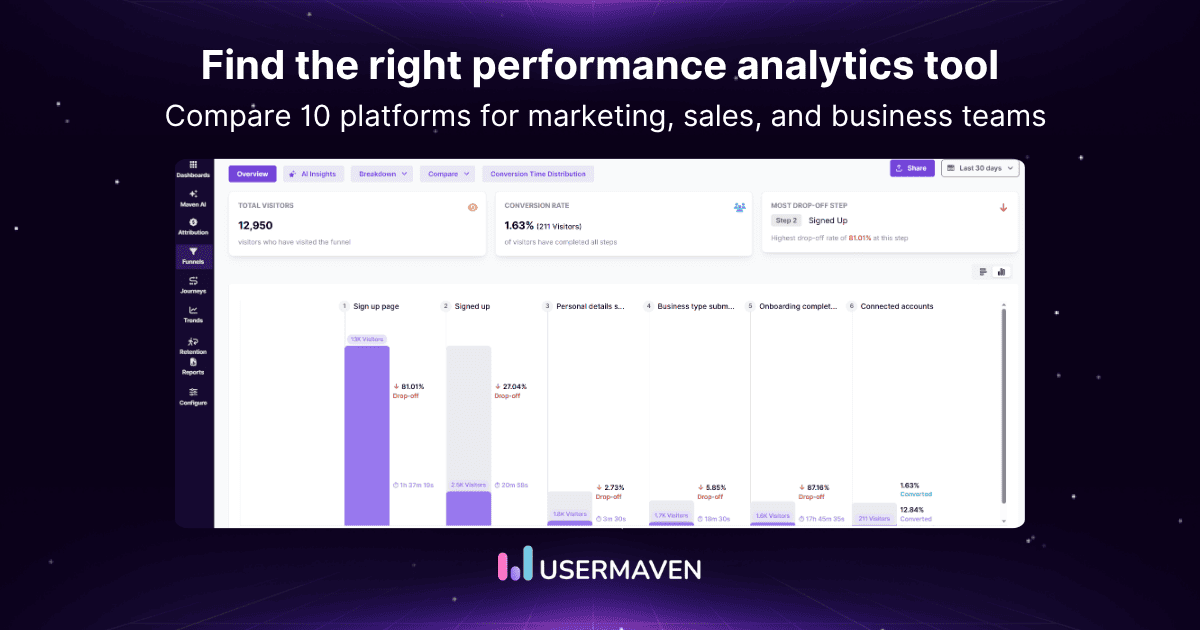
Most performance analytics tools were not built for marketing teams. They were built for data engineers, BI consultants, and enterprise finance teams who have the technical resources to make them work.
The result is that most marketing teams either overpay for platforms they cannot fully use or rely on platform-reported numbers that inflate results and mislead budget decisions.
This guide reviews the 10 best performance analytics tools available in 2026, matched to the use cases they actually serve best. Whether you need marketing performance analytics software, a sales performance analytics platform, or a business performance analytics dashboard, every major option is covered here.
For a full understanding of what performance analytics is and how it works across business functions, see the complete performance analytics guide first.
Key takeaways
- Performance analytics tools help businesses collect, measure, and act on performance data across marketing, sales, e-commerce, and operations
- The best tools go beyond dashboards to connect activity metrics directly to revenue outcomes that match CRM data
- Choosing the right platform depends on your primary use case: marketing attribution, sales tracking, product analytics, or business-wide BI
- Pricing ranges from free entry-level options to enterprise-tier platforms exceeding $2,000 per month, depending on scale and features
- Usermaven delivers marketing performance analytics with independent attribution, seven attribution models, AI-powered insights, and no-code setup starting at $84/month
What are performance analytics tools?
Performance analytics tools are software platforms that collect, measure, and visualise performance data to help teams track progress against goals, identify what is working, and make faster, more confident decisions.
They differ from raw reporting tools in one key way: they are built to answer questions about performance rather than just display data. A good performance analytics tool does not just show what happened, it shows whether performance is on track and what actions are available.
What performance analytics software covers across different functions:
- Marketing teams: campaign attribution, channel performance, conversion tracking, and ROAS measurement
- Sales teams: pipeline health, rep performance, win rate analysis, and revenue forecasting
- E-commerce brands: revenue by source, conversion funnel, product performance, and repeat purchase rate
- Business leaders: cross-functional KPI dashboards, revenue tracking, and growth metrics across all functions
The distinction between a marketing analytics tool and a broader BI platform is important: one is purpose-built for a specific function with pre-built metrics, the other requires custom setup by a dedicated analytics team.
10 best performance analytics tools in 2026
Each tool below is reviewed against the same format so you can compare directly. Criteria: data accuracy, attribution coverage, ease of use, pricing, and the specific use case each tool serves best.
1. Usermaven: Best overall for marketing performance analytics
Overview
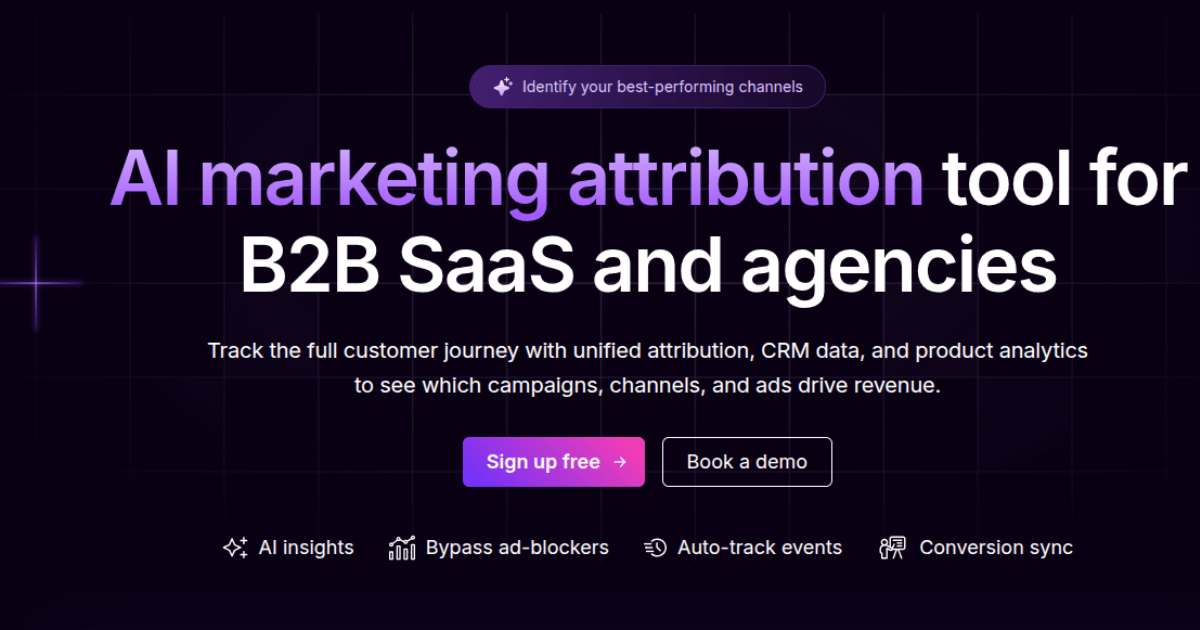
Usermaven is an AI-powered marketing attribution platform that connects ad platforms, CRM, and website data to track the full customer journey in real time using first-party and server-side tracking across every paid channel you run.
How it works
Usermaven places a first-party pixel that bypasses most ad blockers and collects session data independently of what any ad platform reports. All channel data feeds into one attribution workspace.
The website analytics software layer handles full-site tracking, while the marketing attribution software connects every paid touchpoint to revenue outcomes. Maven AI answers performance questions in plain language without SQL or developer support.
Key highlights
- First-party pixel with ad-blocker bypass for near-complete data accuracy across all browsers and devices
- Seven attribution models, including first-touch, last-touch, linear, time-decay, position-based, data-driven, and custom rules
- Maven AI surfaces which campaigns to scale or pause without manual analysis
- No-code setup in minutes with native integrations for Google Ads, Meta, LinkedIn, Shopify, and more
- Multi-domain tracking for teams and agencies managing multiple properties
- GDPR and CCPA compliant with cookieless tracking built in by default
Pricing
Starts at $84/month for 250K events.
Ideal for
Marketing and growth teams of all sizes that need accurate, unified marketing performance analytics software without enterprise-level cost or developer dependency.
2. Google Analytics: Best free web performance analytics
Overview
Google Analytics 4 is the standard web analytics platform built into the Google ecosystem, offering free traffic and behaviour tracking for any website or app.
How it works
GA4 uses an event-based tracking model where every user interaction is recorded as an event. It connects to Google Ads for basic attribution and uses machine learning to model conversions for users who have opted out of tracking.
Key highlights
- Free with any Google account
- The event-based model tracks any user interaction
- Connects directly to Google Ads and Looker Studio for dashboards
- Predictive metrics using Google’s machine learning for opted-out users
- Cross-device tracking for signed-in Google users through Google Signals
Pricing
Free. GA4 360 (enterprise) starts at approximately $50,000/year.
Ideal for
Teams primarily running Google Ads who need basic web performance analytics and are comfortable with data sampling. See Google Analytics limitations for where GA4 falls short as a standalone performance analytics solution.
3. HubSpot Analytics: Best for CRM and marketing performance combined
Overview
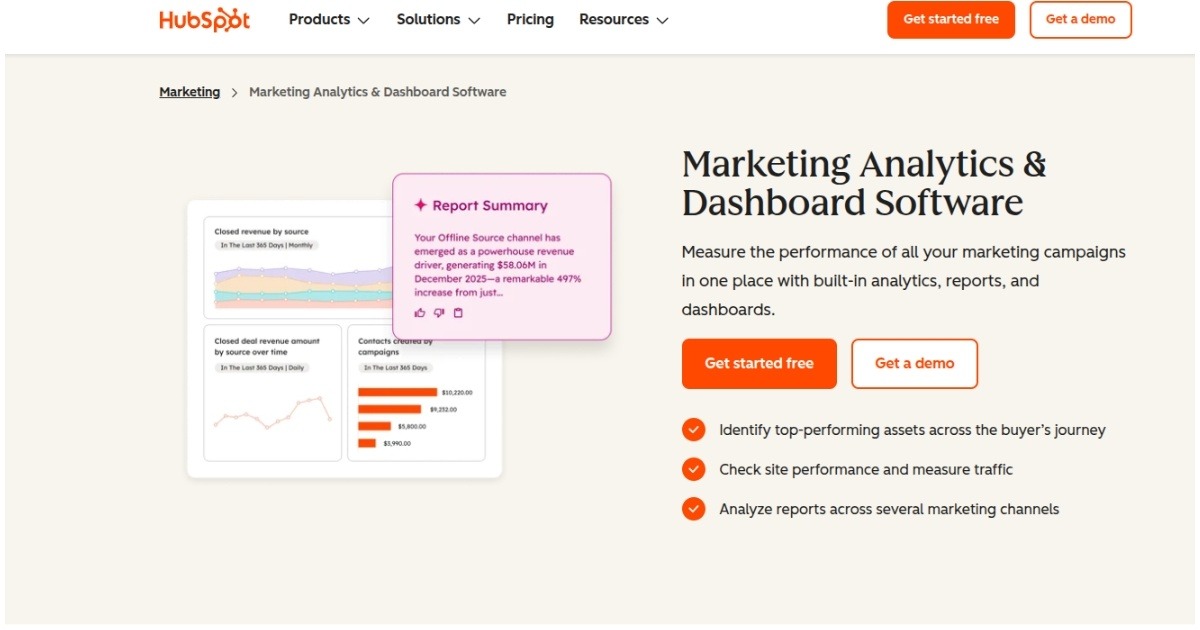
HubSpot Analytics is the reporting and analytics layer built into the HubSpot CRM, covering marketing performance, sales pipeline, and customer journey data in one integrated platform.
How it works
HubSpot tracks contacts through every lifecycle stage from first website visit to closed deal. Marketing and sales data live in the same platform, making it straightforward to see how marketing activity converts into pipeline and revenue without manual data stitching.
Key highlights
- Native CRM integration connects marketing attribution to closed revenue
- Pre-built dashboards for marketing, sales, and service performance reporting
- Multi-touch revenue attribution available on higher tiers
- Strong email, landing page, and content performance tracking
- Customisable dashboards for different team reporting needs and executive views
Pricing
Free tier available. Marketing Hub Professional starts at $890/month.
Ideal for
Teams already in the HubSpot ecosystem that want combined marketing and sales performance analytics without a separate attribution tool.
4. Amplitude: Best for product performance analytics
Overview
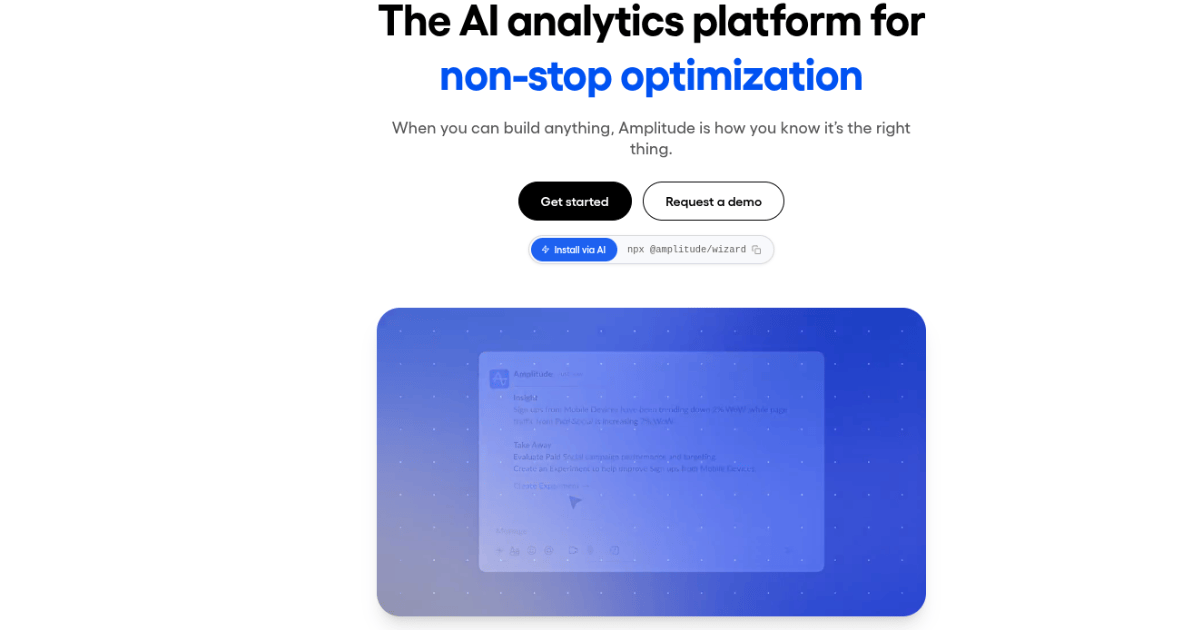
Amplitude is a product analytics platform that tracks how users interact with digital products, measures feature adoption, and connects product usage to retention and revenue outcomes.
How it works
Amplitude instruments product events and build behavioural cohorts to analyse which features drive activation, retention, and expansion. It connects product performance data to revenue metrics and supports experimentation for data-driven product decisions.
Key highlights
- Deep user behavioural analytics beyond page views and session data
- Funnel analysis, retention curves, and cohort comparisons built in
- A/B testing and experimentation features for product-led growth teams
- Strong integration with data warehouses for custom performance analysis
- Session replay available to complement quantitative performance data
Pricing
Free tier up to 10M events/month. Growth plans start at approximately $61/month.
Ideal for
SaaS and digital product teams that need to track feature performance, user retention, and the path from signup to paid conversion.
5. Domo: Best for enterprise BI performance dashboards
Overview
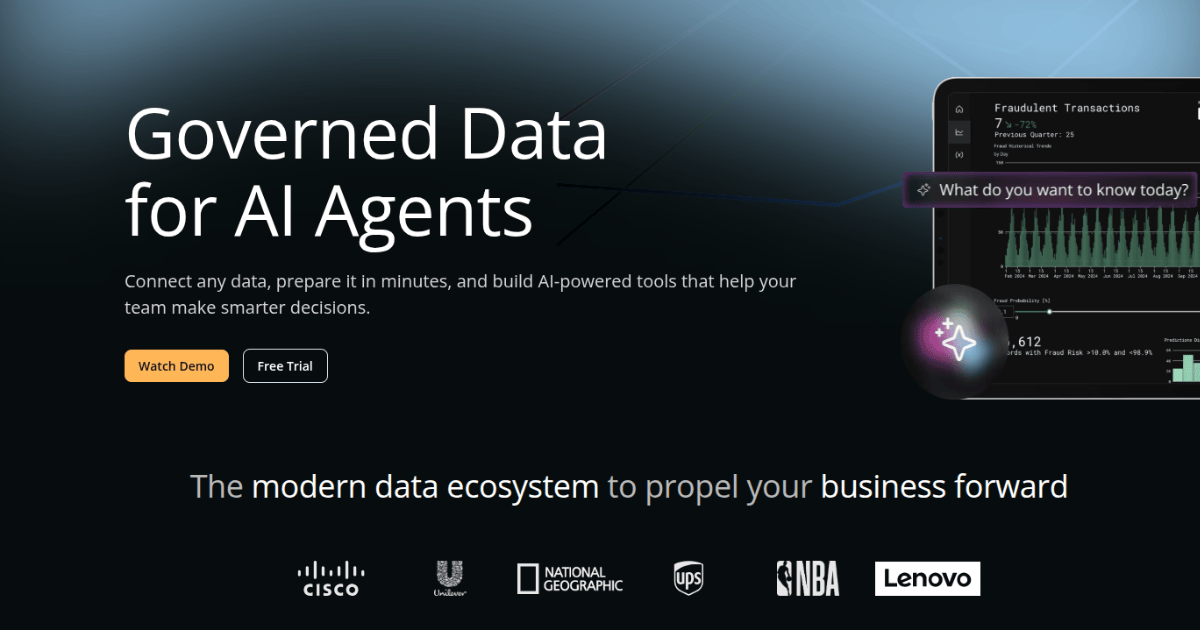
Domo is an enterprise business intelligence platform that connects data from 1,000+ sources into customisable dashboards for cross-functional business performance analytics reporting.
How it works
Domo pulls data from CRM, ERP, marketing, finance, and operational systems through pre-built connectors. Teams build dashboards using a no-SQL interface and share performance views across departments. AI features surface anomalies and trends without manual exploration.
Key highlights
- 1,000+ native connectors covering virtually every business data source
- Cross-departmental performance dashboards combining marketing, sales, finance, and operations
- AI-powered alerts and anomaly detection for proactive performance monitoring
- Embedded analytics for sharing performance data externally with clients or partners
- Strong governance and access control for enterprise compliance environments
Pricing
Contact for pricing. Enterprise-tier platform.
Ideal for
Large organisations that need cross-functional business performance analytics tools combining marketing, sales, finance, and operational data in one governed environment.
6. Tableau: Best for custom performance analytics
Overview
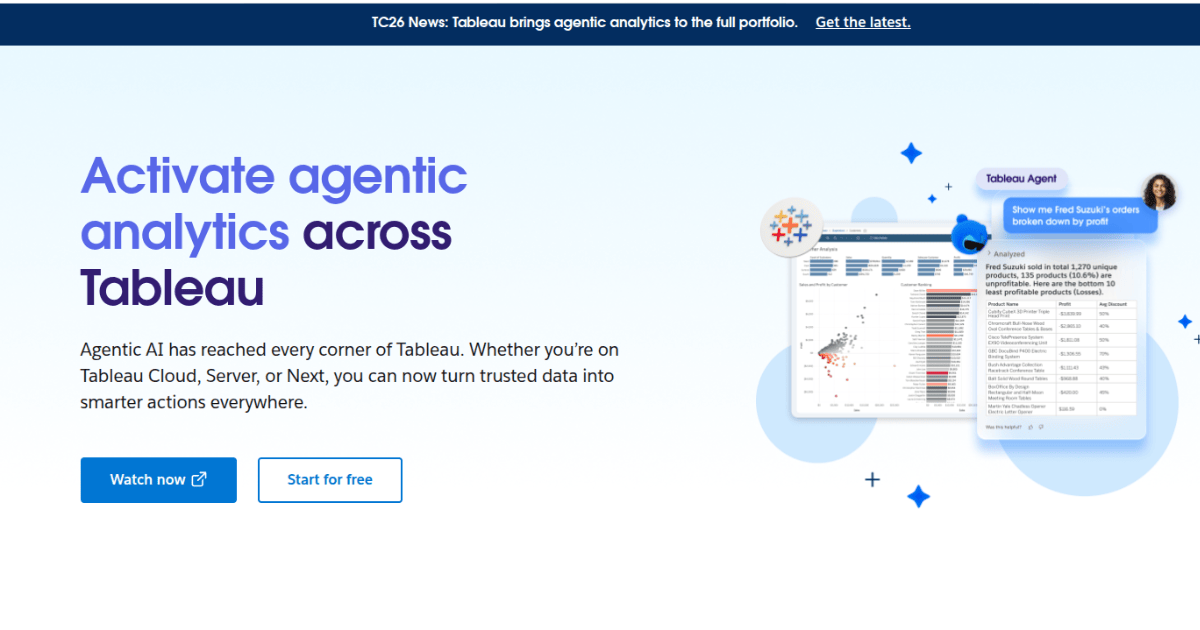
Tableau is a data visualisation and business intelligence platform that allows analysts to build highly customised performance dashboards from virtually any data source.
How it works
Tableau connects to databases, data warehouses, spreadsheets, and cloud sources. Analysts use a drag-and-drop interface to build custom visualisations and performance dashboards. Tableau AI enables natural language queries for non-technical users.
Key highlights
- Unmatched flexibility for custom performance visualisation and dashboard design
- Connects to virtually any data source, including live database connections
- Large community with thousands of pre-built dashboard templates for faster setup
- Tableau AI for natural language performance queries without SQL
- Embedded analytics for sharing performance data in external applications
Pricing
Tableau Creator starts at $180/user/month.
Ideal for
Organisations with dedicated analytics teams that need maximum flexibility to build custom performance dashboards across multiple business functions simultaneously.
7. Salesforce Einstein Analytics: Best for sales performance analytics
Overview
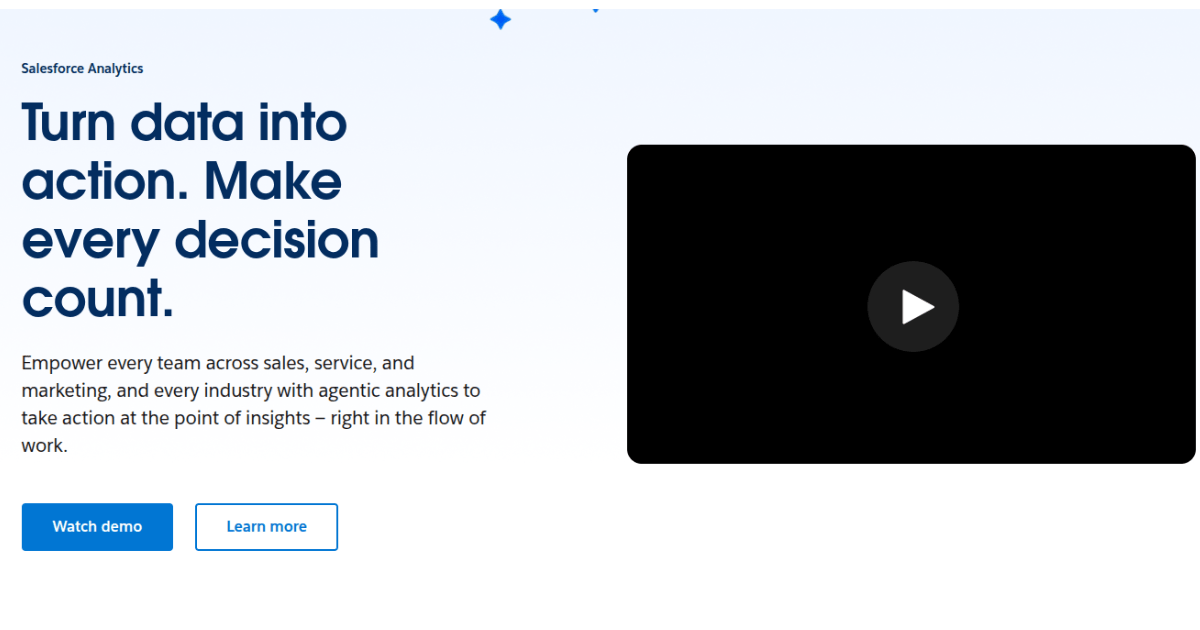
Salesforce Einstein Analytics is the AI-powered analytics layer built into Salesforce CRM, designed specifically for sales performance analytics software and revenue forecasting.
How it works
Einstein Analytics connects directly to Salesforce CRM data to build sales performance dashboards, pipeline health reports, and rep activity tracking. AI features generate revenue forecasts and surface deals at risk without manual analysis by the team.
Key highlights
- Native Salesforce CRM integration for complete pipeline visibility and deal tracking
- AI-powered revenue forecasting and deal risk scoring built into dashboards
- Rep performance tracking against quota at the individual and team levels
- Pre-built sales performance dashboards ready from day one without custom setup
- Connects marketing attribution data to closed revenue through the CRM layer
Pricing
Starts at $180/user/month for Einstein Analytics.
Ideal for
Sales teams and revenue operations leaders already in the Salesforce ecosystem who need deep sales performance analytics software without a separate BI implementation.
8. Cometly: Best for ad performance analytics
Overview
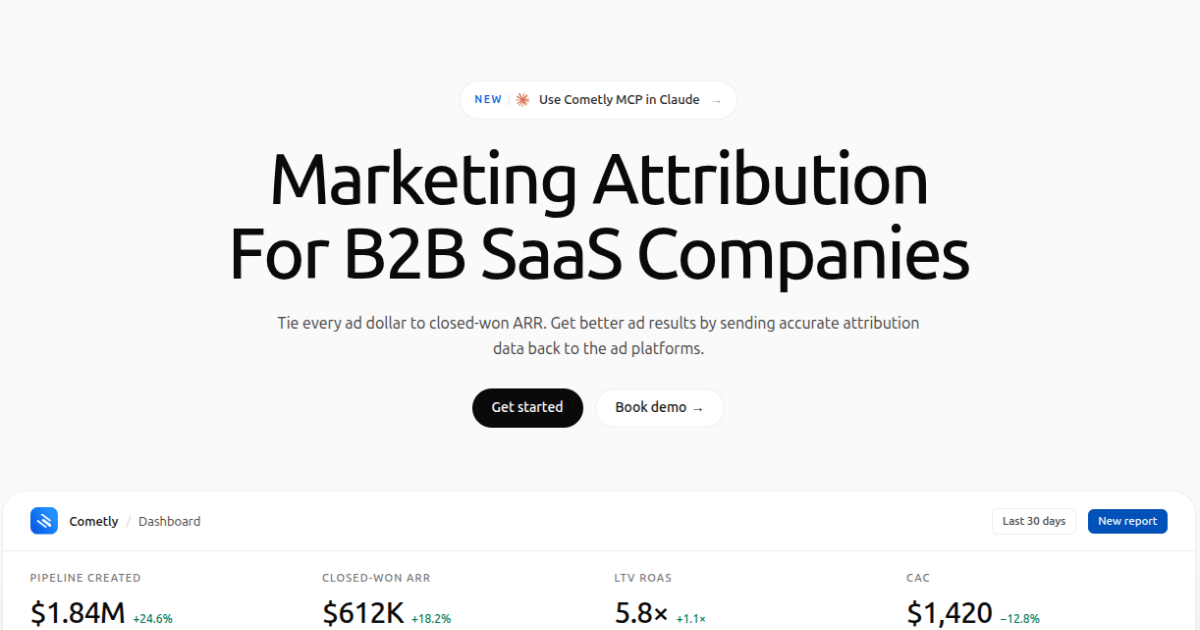
Cometly is an attribution platform that uses first-party and server-side tracking to connect ad spend to closed revenue, specifically for performance marketing teams and agencies.
How it works
Cometly places a first-party pixel alongside server-side Conversions API connections to capture conversion data that browser-only tools miss. Attribution data syncs back to Meta and Google for smarter automated bidding.
Key highlights
- First-party server-side tracking for iOS and ad-blocker-resistant attribution
- Real-time dashboard showing which ads generate revenue, not just clicks or cheap leads
- CRM and warehouse sync for full-funnel revenue attribution
- Multi-account management for agency clients without redundant setup
Pricing
It starts at 750$ per month for 50K sessions.
Ideal for
Performance agencies and paid acquisition teams that need ad-level attribution accuracy with CRM-connected revenue data. See the full ad tracking software comparison for more options in this category.
9. Mixpanel: Best for user behaviour and retention analytics
Overview
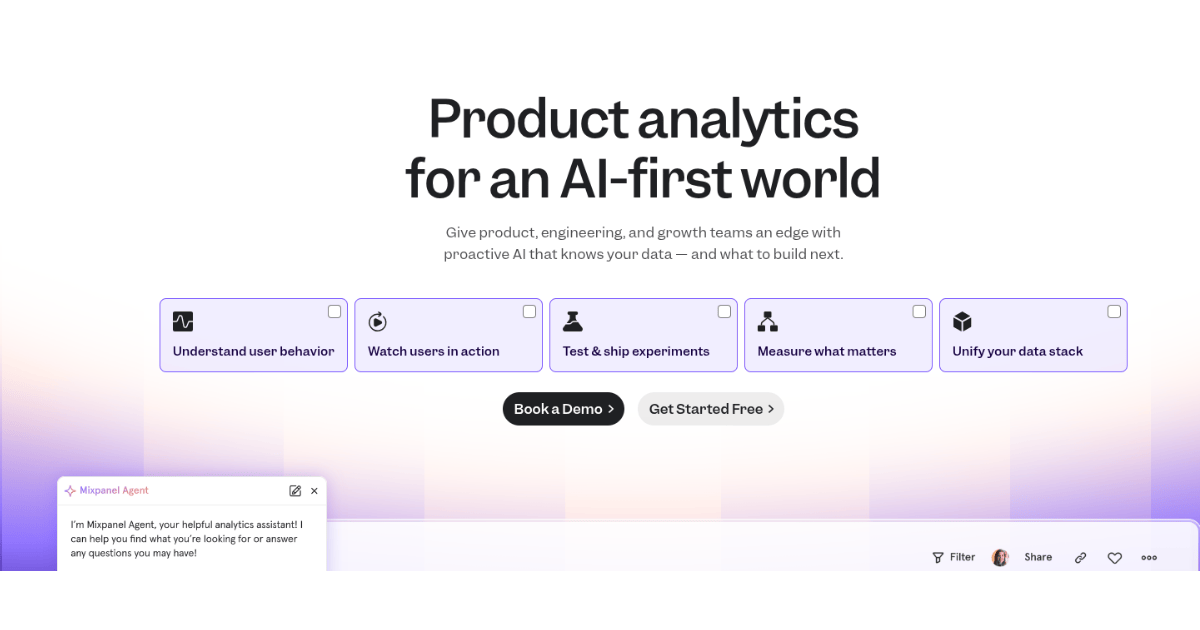
Mixpanel is a product and user behaviour analytics platform that tracks how users engage with digital products and connects engagement patterns to retention and revenue outcomes.
How it works
Mixpanel tracks events across web and mobile products and builds user-level analytics that show the exact path from acquisition to activation to retention. Funnel reports, retention curves, and cohort analysis are built in from the start.
Key highlights
- User-level event tracking across web and mobile with session-level detail
- Funnel analysis showing exactly where users drop off in any flow
- Retention and cohort analysis for subscription and SaaS businesses
- Automated insights surfacing performance anomalies without manual exploration
- Data export to warehouses for custom performance analysis and modelling
Pricing
Free tier up to 1M events. The Growth plan starts at $140/month per 1K events.
Ideal for
Product and growth teams at SaaS and consumer app companies that need deep user behaviour analytics to improve retention and product-led growth performance.
10. Databox: Best for KPI tracking and business performance dashboards
Overview
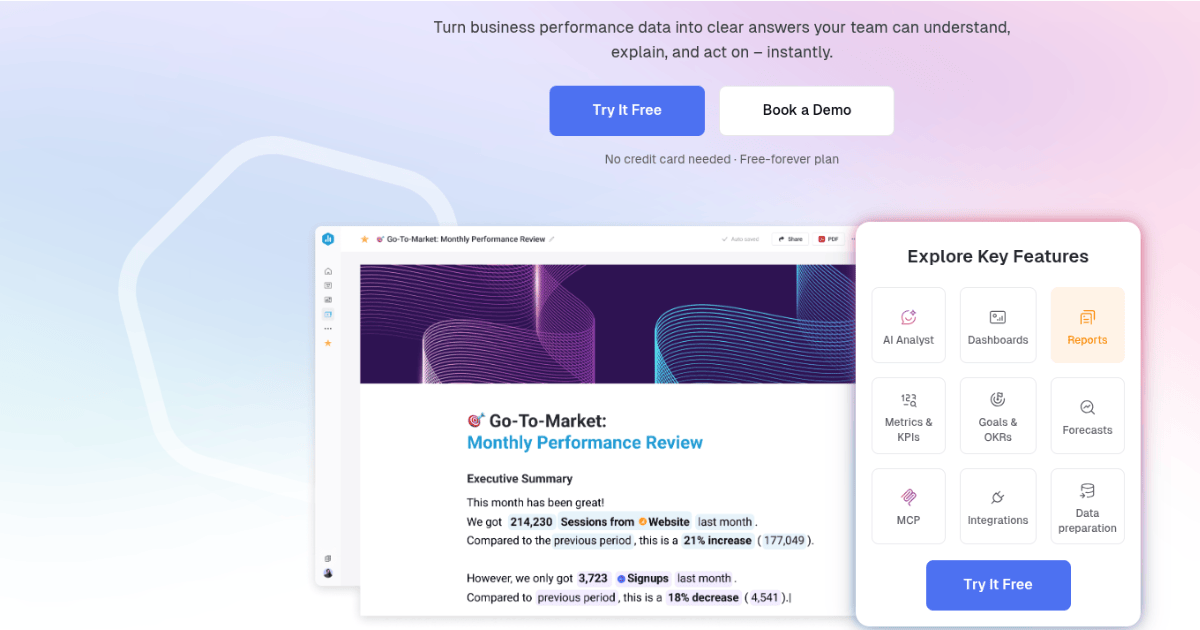
Databox is a business analytics platform that connects 100+ data sources into one customisable KPI dashboard, designed for non-technical teams who need performance visibility without BI setup complexity.
How it works
Databox pulls metrics from Google Analytics, HubSpot, Salesforce, Meta Ads, and 100+ other sources through pre-built integrations. Teams build dashboards using a drag-and-drop interface and set up automated alerts when metrics move outside defined thresholds.
Key highlights
- 100+ native integrations with no-code setup for fast time to first dashboard
- Pre-built dashboard templates for marketing, sales, and executive performance reporting
- Automated performance alerts when KPIs hit or miss defined targets
- Goals and benchmarks visible alongside current performance data
- Affordable entry point for small and mid-size teams without enterprise budgets
Pricing
Free tier for 3 users. Professional starts at $79/month.
Ideal for
Small to mid-size marketing and business teams that need a unified performance dashboard across multiple tools without BI complexity or enterprise-level cost.
[product_analytics]
Performance analytics tools comparison table
Use this performance analytics tools comparison to shortlist before committing time to demos and trials.
For broader context on verified user ratings across all major platforms, see the G2 business analytics category and Gartner BI platform reviews for independent evaluation data.
| Tool | Best for | Starting price | First-party tracking | Attribution models | No-code setup |
|---|---|---|---|---|---|
| Usermaven | Marketing performance analytics | $84/month | Yes | 7 models + AI | Yes |
| Google Analytics 4 | Free web analytics | Free | Partial | Last-click | Yes |
| HubSpot Analytics | CRM + marketing combined | $890/month | Partial | Multi-touch | Yes |
| Amplitude | Product performance analytics | $61/month | Yes | Limited | Yes |
| Domo | Enterprise BI dashboards | Contact sales | Partial | Limited | Partial |
| Tableau | Custom analytics | $180/user/month | Partial | Custom | No |
| Salesforce Einstein | Sales performance analytics | $180/user/month | Partial | Limited | Partial |
| Cometly | Ad performance analytics | $750/month | Yes | Multi-touch | Yes |
| Mixpanel | User behaviour analytics | $140/month per 1K events | Yes | Limited | Yes |
| Databox | KPI dashboards | $79/month | No | No | Yes |
How to choose the right performance analytics tool
The right performance analytics platform starts with your use case, not the feature list of the most expensive tool on this list.
For marketing teams focused on attribution accuracy
Usermaven for independent multi-touch attribution across all paid and organic channels. GA4 for teams that are Google-only and comfortable with modeled conversion data.
The guide to cross-channel marketing attribution explains why independent attribution consistently produces different and more accurate numbers than platform-reported data.
For sales teams and revenue operations
Salesforce Einstein Analytics for teams already in the Salesforce CRM. HubSpot Analytics for combined marketing and sales performance in one platform. Both connect pipelines to closed revenue but with different integration requirements and pricing structures.
For product and SaaS teams
Amplitude for feature adoption and retention analytics. Mixpanel for user behaviour and funnel analysis with cohort tracking. Both provide the product performance analytics that marketing-only tools do not cover.
For enterprise and cross-functional reporting
Domo for large organisations combining marketing, finance, and operations data with strong governance. Tableau for custom BI with dedicated analytics team support and maximum visualisation flexibility.
For small teams and startups
Databox for accessible KPI dashboards at low cost. GA4 for free basic web performance. Usermaven starting at $84/month for the most complete marketing performance analytics software at an accessible price point.
For a deeper dive into paid media attribution specifically, the complete guide to ad tracking software covers the tools and criteria that matter most for performance marketing teams.
What to look for in performance analytics software
Evaluating performance analytics platforms against these criteria before committing to a trial saves significant time and budget.
Accuracy of underlying data
A performance analytics tool is only as reliable as the data it collects. Tools that depend solely on platform-reported numbers or third-party cookies produce inflated results. Look for first-party data collection, server-side tracking options, and ad-blocker bypass capability as baseline requirements.
Attribution coverage
For marketing teams, the most important question a performance analytics tool must answer is which channels actually drive revenue. Look for multi-touch attribution models, not just last-click, and independent tracking that sits above individual platform dashboards.
Dashboard customisation and ease of use
Enterprise BI tools offer maximum flexibility but require data engineering support. Marketing-focused platforms offer pre-built dashboards that teams can use from day one. Match the tool’s complexity to your team’s technical capacity.
Integration depth
Verify native connections to your CRM, ad platforms, ecommerce stack, and data warehouse. Shallow integrations break silently and create gaps that teams rarely notice until a quarterly review surfaces an unexplained performance swing.
Pricing scalability
Entry-level tools start free or near-free. Enterprise platforms reach $2,000 per month and above. Match tool cost to the revenue it protects rather than assuming the most expensive option produces the most accurate data.
Privacy compliance
GDPR and CCPA compliance are legal requirements for brands serving European or California audiences. Look for cookieless tracking and consent management built in by default, not added as a paid upgrade.
[fix_whats_not]
Conclusion
The best performance analytics tool is not the one with the most features. It is the one that answers the specific questions your team needs to answer, connects the right data sources, and produces numbers your business can act on.
The wrong tool does not just waste money. It produces wrong answers that drive wrong decisions.
The right tool does not just report performance. It changes how your team allocates time and budget across every channel and campaign.
Not sure where to start? Usermaven’s guided analytics setup connects every data source your marketing team needs and builds your performance analytics layer in minutes.
Try Usermaven free with no credit card required. Or book a free demo to see what accurate marketing performance analytics looks like.
FAQs
1. What are performance analytics tools?
2. What is the best performance analytics software in 2026?
3. What is performance analytics software?
4. What tools support performance analytics for marketing teams?
The right combination depends on channel mix, technical capacity, and whether you need attribution that reconciles with CRM revenue or just platform-level reporting. See the guide to marketing attribution models for how the attribution method affects which tool to choose.
5. Which performance analytics tools work best for small teams?
For small teams where ad platform discrepancies are creating budget waste, Usermaven’s independent attribution layer quickly pays for itself by preventing misallocated spend.