Every click, purchase, signup, and customer interaction generates valuable data. The challenge is knowing how to turn that data into meaningful business decisions.
Predictive analytics and prescriptive analytics help businesses do exactly that.
Predictive analytics uses historical data, machine learning, and statistical models to forecast future outcomes such as customer churn, product demand, or conversion likelihood. Prescriptive analytics goes beyond forecasting by recommending the best actions businesses should take to achieve better results.
Although they are often mentioned together, predictive and prescriptive analytics serve different purposes and require different analytical approaches. Let’s find out how these two concepts differentiate.
What is predictive analytics?
Predictive analytics is a type of advanced data analytics that uses historical data, machine learning, statistical models, and behavioral patterns to forecast future outcomes. It helps businesses predict trends, customer behavior, churn risk, sales performance, and conversion likelihood before they happen.
It answers questions like:
- Which users are at risk of canceling?
- How likely is a free trial user to upgrade?
- What time is best to re-engage inactive users?
Example:
Imagine an ecommerce brand analyzing customer data. It finds that users who view a product more than three times but don’t add it to the cart within 24 hours are unlikely to buy. Predictive analytics can identify similar behavior patterns across users. This allows the team to automatically send a discount or reminder email before the customer disappears.
This kind of insight transforms how you work. You’re no longer reacting to lost sales or churn reports; you’re predicting and preventing them.
Tools like Usermaven simplify this process by automatically tracking events, funnel progress, and retention patterns. Then, using machine learning models, it helps you predict which users need attention so your marketing and product teams can step in early.
What is prescriptive analytics?
Prescriptive analytics is an analytics method that recommends the best action to take based on predictive insights and real-time data.
It doesn’t stop at forecasting but goes a step further to recommend or even automate the best next action. Prescriptive analytics uses optimization, simulation, and AI decision models to suggest what should happen next.
If predictive analytics tells you what might happen, prescriptive analytics tells you what to do about it.
Example:
Let’s say predictive analytics identifies a group of users at high risk of churn. Prescriptive analytics might then suggest:
- Sending a personalized retention email
- Offering a discount on renewal, or
- Triggering a support check-in.
Instead of simply knowing “who’s about to leave,” you know how to keep them.
Usermaven helps you act on these insights with built-in funnels, retention tracking, and data-driven attribution. By connecting predictive signals with prescriptive actions, you can move from insight to intervention faster and more effectively.
[business_growth]
Predictive analytics vs prescriptive analytics
Predictive analytics and prescriptive analytics are both advanced analytics methods, but they serve different purposes.
Predictive analytics helps businesses forecast future outcomes using historical data, machine learning, and forecasting models. Prescriptive analytics goes a step further by recommending the best actions based on those predictions.
In simple terms, predictive analytics tells you what is likely to happen, while prescriptive analytics helps you decide what to do next.
| Aspect | Predictive analytics | Prescriptive analytics |
| Goal | Predict future outcomes | Recommend the best action |
| Input data | Historical data, behavioral data, trends | Predictive insights, real-time data, business rules |
| Output | Forecasts, probabilities, risk scores | Recommendations, automated actions, decision strategies |
| Techniques | Machine learning, regression analysis, forecasting models, data mining | Optimization algorithms, simulations, AI decision models, reinforcement learning |
| Complexity | Moderate | High |
| Business value | Improves forecasting and risk management | Improves decision-making and operational efficiency |
| Example use cases | Churn prediction, sales forecasting, fraud detection | Dynamic pricing, retention campaigns, inventory optimization, personalized recommendations |
Together, predictive and prescriptive analytics help businesses improve forecasting, automate decisions, reduce churn risk, and deliver more personalized customer experiences.
Descriptive vs. predictive vs. prescriptive analytics
Modern data analytics is often divided into four stages, with each stage helping businesses answer a different question.
- Descriptive analytics (What happened?)
Descriptive analytics uses historical data, reports, and dashboards to track past performance and business metrics.
Example: An ecommerce store analyzes monthly sales and website traffic.
- Diagnostic analytics (Why did it happen?)
Diagnostic analytics helps identify the reasons behind trends, customer behavior, or performance changes.
Example: A SaaS company discovers that onboarding friction caused a drop in conversions.
- Predictive analytics (What will happen?)
Predictive analytics uses machine learning, forecasting models, and behavioral data to predict future outcomes like churn risk or sales trends.
Example: A streaming platform predicts which users are likely to cancel subscriptions.
- Prescriptive analytics (What should we do?)
Prescriptive analytics recommends the best actions using AI, optimization models, and decision intelligence systems.
Example: A retail app automatically sends personalized offers to reduce customer churn.
How predictive and prescriptive analytics work together
Predictive and prescriptive analytics are most effective when they work together as part of a real-time decision-making system.
Predictive analytics identifies what is likely to happen, while prescriptive analytics recommends the best action based on those predictions.
Here’s how the process typically works:
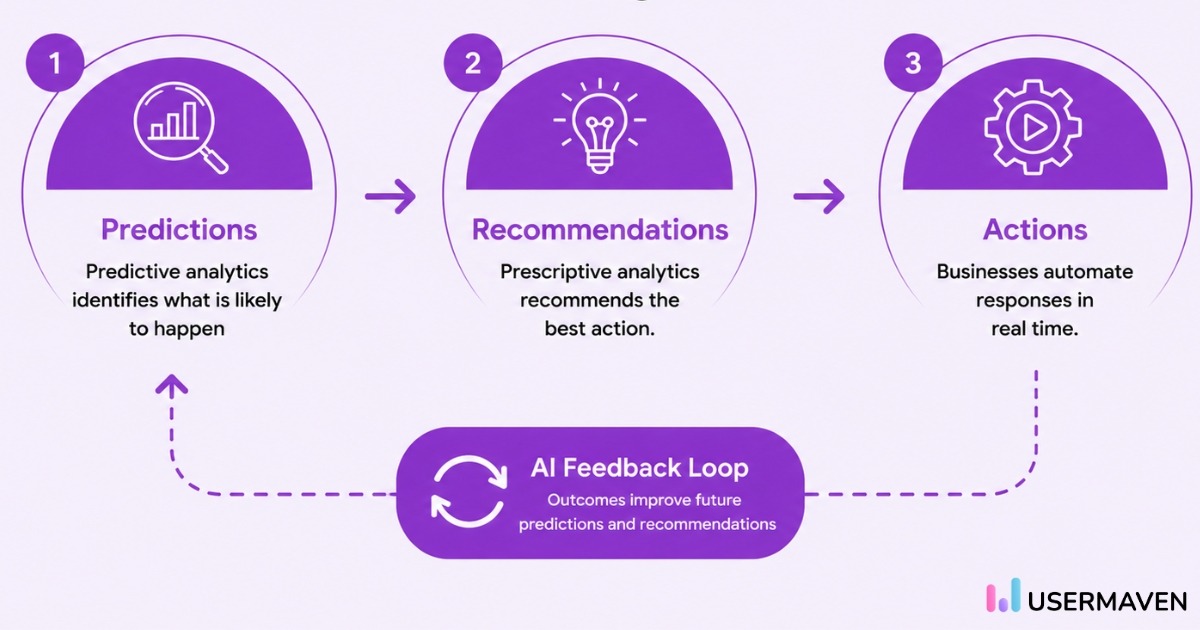
- Predictions: Predictive analytics analyzes historical data, customer behavior, and usage patterns to identify future risks or opportunities.
- Recommendations: Prescriptive analytics uses AI models, optimization algorithms, and recommendation engines to suggest the most effective next step.
- Actions: Businesses can automate responses in real time, such as sending personalized offers, adjusting pricing, or triggering alerts.
Many modern analytics systems also use AI feedback loops, where outcomes from previous actions help improve future predictions and recommendations.
Common technologies used in predictive and prescriptive analytics
Predictive and prescriptive analytics rely on several advanced technologies to process data, identify patterns, and improve business decision-making. Many businesses also use AI software development solutions to build and scale these analytics systems more efficiently.
In some cases, companies also invest in custom software development to create analytics workflows, automation systems, and AI models tailored to their specific business needs.
- Machine learning: Helps analytics systems learn from historical and real-time data to improve predictions over time.
- Regression analysis: Uses statistical methods to identify relationships between variables and forecast future outcomes like revenue, churn, or demand.
- Neural networks: AI models designed to recognize complex patterns in large datasets, often used in customer behavior analysis and fraud detection.
- Decision trees: Analyze different possible outcomes and help businesses make data-driven decisions based on conditions and probabilities.
- Optimization algorithms: Used in prescriptive analytics to recommend the most effective action or strategy.
- Reinforcement learning: Allows AI systems to continuously improve decisions based on previous outcomes and feedback.
- Simulation models: Test different business scenarios to predict risks, opportunities, and potential results.
- Data warehouses: Store and organize large volumes of business data used for analytics, forecasting, reporting, and AI-driven analytics workflows.
Real-world use cases by industry
Predictive and prescriptive analytics are used across industries to improve forecasting, automate decision-making, and deliver better customer experiences.
Ecommerce
- Predictive analytics: Ecommerce brands use predictive analytics to forecast customer demand, predict cart abandonment, and identify shoppers who are likely to churn.
- Prescriptive analytics: Prescriptive analytics helps recommend personalized discounts, product suggestions, and dynamic pricing strategies to improve conversions and customer retention.
SaaS
- Predictive analytics: SaaS companies analyze product usage and customer behavior data to predict churn risk, feature adoption, and trial-to-paid conversions.
- Prescriptive analytics: Teams can automate onboarding flows, trigger customer success alerts, and personalize in-app experiences based on predictive insights.
Healthcare
- Predictive analytics: Healthcare providers use predictive models to forecast patient risks, hospital readmissions, and disease outbreaks.
- Prescriptive analytics: Prescriptive systems help recommend treatment plans, optimize staff scheduling, and improve operational efficiency.
Finance
- Predictive analytics: Financial institutions use predictive analytics for fraud detection, credit scoring, investment forecasting, and risk assessment.
- Prescriptive analytics: AI-driven systems can automatically flag suspicious transactions, recommend investment strategies, and optimize financial planning.
Logistics
- Predictive analytics: Logistics companies use forecasting models to predict delivery delays, inventory demand, and supply chain disruptions.
- Prescriptive analytics: Prescriptive analytics helps optimize delivery routes, warehouse operations, and inventory management in real time.
Benefits and limitations of predictive and prescriptive analytics
Predictive and prescriptive analytics can both improve decision-making, but they also come with practical limitations.
The table below shows the main benefits and challenges of each approach.
| Type | Benefits | Limitations |
| Predictive analytics | Improves forecasting, identifies churn risks, predicts customer behavior, supports fraud detection, and helps businesses make proactive decisions. | Inaccurate data can reduce prediction accuracy, models may become outdated over time, and forecasts are based on probabilities rather than guaranteed outcomes. |
| Prescriptive analytics | Recommends the best actions, automates workflows, improves operational efficiency, and helps businesses personalize customer experiences in real time. | More complex to implement, requires strong data infrastructure and AI capabilities, and may involve higher implementation and maintenance costs. |
How Usermaven helps teams build a strong analytics foundation
Predictive and prescriptive analytics depend on accurate and well-structured data. Without reliable customer and product data, businesses can struggle to generate useful insights or make informed decisions.
Usermaven helps solve this by giving teams a clear view of customer behavior across websites and products.
With automatic event tracking, teams can capture user interactions without complex manual setup. Funnel analysis helps identify where users drop off in the customer journey. Behavioral analytics makes it easier to understand engagement patterns and product usage trends.
Usermaven also offers user segmentation, attribution reporting, customer journey tracking, and conversion analytics. These features help marketing and product teams understand which channels, campaigns, and touchpoints drive growth.
This structured data foundation makes it easier to improve reporting, analyze customer behavior, and support future predictive analytics and AI-driven decision-making strategies.
Final thoughts
Predictive analytics and prescriptive analytics are helping businesses move beyond basic reporting and make faster, smarter, and more proactive decisions. While predictive analytics helps forecast future outcomes, prescriptive analytics helps businesses choose the best actions based on those insights.
To make these analytics strategies effective, businesses need accurate customer data, behavioral insights, and clear visibility into the customer journey. Without a strong data foundation, even the most advanced AI and analytics models can produce unreliable results.
Usermaven solves this by helping teams build a stronger analytics foundation.
With advanced analytics and marketing attribution software features, teams can better understand user behavior and customer journeys.
Ready to experience the best tool for smarter growth decisions? Book a demo and see how Usermaven helps you uncover actionable insights faster.
[insight_growth]