Marketing attribution is easy to talk about and much harder to get right.
Most teams already have data coming in from different channels and campaign touchpoints. The problem is figuring out how those interactions connect to pipeline and revenue in a way you can actually trust.
That is what makes Dreamdata vs. HockeyStack vs. Bizible a meaningful comparison. While all three platforms support attribution, they differ in how they approach journey visibility, reporting, and revenue analysis.
In this guide, we will take a closer look at each tool and the areas that matter most, so you can better understand how they compare and which one is the right fit for your team.
Understanding B2B marketing attribution
B2B marketing attribution is the process of understanding how marketing contributes to the pipeline and revenue. It helps teams move beyond surface-level performance and get a clearer view of how growth actually takes shape.
That matters because B2B buying journeys are rarely linear. A deal can build over weeks or months, involve multiple interactions, and include several stakeholders before a real buying decision is made.
This is what makes B2B attribution more complex than B2C attribution. Instead of a shorter path to purchase, it has to reflect a longer, more layered journey where influence builds gradually across different stages.
When attribution is done well, it becomes much more than a reporting exercise. It helps teams see what is creating momentum, where marketing is making an impact, and how to make smarter decisions about future investment.
Breaking down each attribution platform
Here’s a quick overview of what each platform offers and where it may be a better fit.
1. Dreamdata
Dreamdata is a B2B attribution and activation platform designed to help teams understand how buyer journeys influence pipeline and revenue. It focuses on making marketing and sales interactions easier to follow through with attribution reporting, journey analysis, and revenue insights.
It is typically considered by companies that want attribution to sit closer to revenue reporting rather than operate as a standalone marketing view. As with most tools in this category, the overall fit depends on how your team handles reporting, implementation, and day-to-day use.
Advantages
- Built specifically for B2B attribution use cases.
- Includes buyer journey and revenue reporting features.
- Supports integrations across common go-to-market tools.
Disadvantages
- The learning curve can be steep, which may slow the time to value for smaller teams.
- Reporting is a recurring weak spot, especially for teams that need more flexibility or a more intuitive view.
- Its broader product scope can feel heavier for teams without dedicated ops support.
- Pricing is less transparent for larger buyers, which can make comparison harder during evaluation.
Related: 8 Dreamdata alternatives you should know
2. HockeyStack
HockeyStack is a B2B attribution and revenue reporting platform that focuses on buyer journey analysis, account-level visibility, and pipeline reporting. It brings together attribution data with a broader view of how marketing activity connects to revenue over the course of a B2B sales cycle.
It is often evaluated by teams that want attribution reporting to be closely tied to pipeline and revenue performance. That makes it a relevant option for companies comparing tools based on reporting structure, measurement needs, and overall fit with their existing go-to-market setup.
Advantages:
- Built around B2B attribution, buyer journey reporting, and pipeline visibility.
- Supports LinkedIn impression tracking and multiple attribution models.
- Includes forecasting, lift report, and marketing mix modeling.
Disadvantages:
- The learning curve can be steep, especially for teams getting started with attribution.
- Reporting may feel less intuitive, particularly when you need answers quickly.
- Initial setup may take more time for teams with more specific reporting needs.
- Pricing is less transparent upfront, which can make evaluation harder.
Quick note: If you find the reporting logic too complex, you may want to evaluate a HockeyStack alternative designed for quicker analysis.
3. Bizible
Bizible, now Adobe Marketo Measure, is a B2B attribution platform that tracks how marketing activity connects to pipeline, revenue, and ROI. It is part of Adobe’s Marketo offering and is built around multi-touch attribution for B2B reporting.
The platform is centered on attribution modeling and revenue reporting, which gives it a more structured feel from the start. That can work for teams that already have established reporting processes, though the overall experience will depend on how much setup, flexibility, and usability your team expects from an attribution tool.
Advantages:
- Includes multiple attribution models for B2B reporting.
- Connects closely with Adobe’s Marketo ecosystem.
- Supports ad platform integrations for campaign cost and performance data.
Disadvantages:
- Pricing is not publicly available, so buyers need to reach out to the sales team for more details.
- Setup may take more time for teams with more complex reporting needs.
- Some users say day-to-day reporting feels less intuitive than expected.
- It tends to be a better fit for larger teams with more established marketing operations.
The key differences at a glance
To make the differences easier to compare, let’s look at the three tools side by side.
| Attribute | Dreamdata | HockeyStack | Bizible |
| Feature set | Attribution, journey reporting, activation, and revenue analytics | Attribution, buyer journey reporting, forecasting, lift analysis, and marketing mix modeling | Multi-touch attribution, ROI reporting, and structured attribution models |
| Ease of use | May take time to get comfortable with | Learning curve can be steep at first | Can feel more involved in day-to-day use |
| Integrations | Broad GTM and data integrations | Connects with marketing, sales, and revenue data sources | Strong fit within Adobe Marketo workflows |
| Reporting and analytics | Journey and revenue reporting with attribution views | Attribution tied to pipeline and revenue reporting | Model-based attribution and ROI measurement |
| Pricing | Free plan available; custom pricing for advanced plans | Custom pricing | Custom pricing |
| Target audience | B2B teams with established attribution needs | B2B teams focused on revenue analytics | Teams using structured B2B attribution within Marketo/Adobe setups |
For teams narrowing down attribution tools, a Dreamdata alternative may become more relevant when ease of use, flexibility, or transparent pricing are harder to compromise on.
Choosing the right tool for your business
The right tool should match your reporting needs, your workflow, and the level of complexity your team can realistically support.
Here are a few things that tend to matter most during that decision:
- Reporting needs: Think about whether you need basic attribution, fuller journey visibility, or reporting that ties more closely to revenue.
- Implementation: Some tools take more time and support to set up, especially when reporting needs are more involved.
- Usability: If reporting takes too much effort to navigate, the data becomes harder to use in regular decision-making.
- Integrations: Attribution works better when your CRM, ad platforms, and other data sources connect cleanly from the start.
- Pricing: When pricing is not public, it can take longer to understand the real cost behind the platform.
- Team fit: Some tools make more sense for teams with established ops support, while others are easier to manage with fewer resources.
Also read: Multi-touch attribution vs. marketing mix modeling
[contacts_hub_v2]
Why Usermaven is a stronger fit for modern attribution
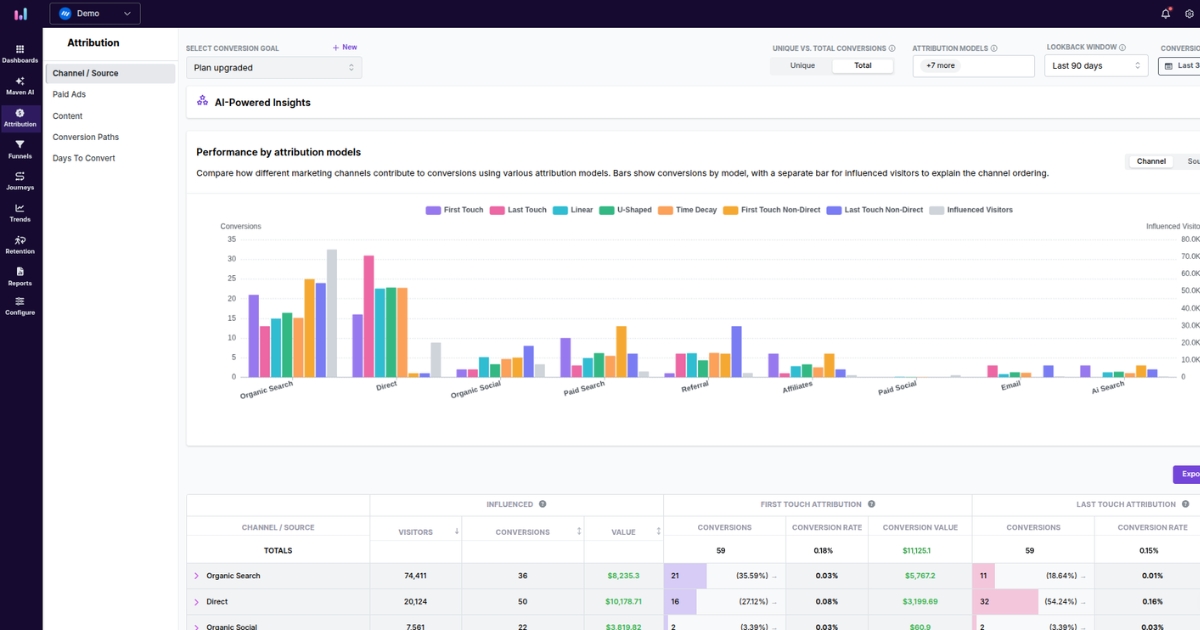
Usermaven is an advanced attribution platform built for teams that want a clearer view of what is actually driving conversions, pipeline, and revenue. It is especially well-suited to B2B marketing, where longer journeys and multiple touchpoints make attribution harder to read with a narrow or single-touch view.
It also makes that analysis easier to put into practice. With a no-code setup and transparent, flexible pricing, teams can get started faster and scale their attribution without being pushed into a heavier implementation process from the start.
What makes it even more useful is that attribution does not sit on its own. Usermaven brings it together with website analytics, product analytics, funnel analysis, and user journeys, so teams can see both what gets credit and what actually moves the journey forward.
Here’s what you get with Usermaven:
- Advanced revenue attribution: Track how marketing efforts contribute to conversions across the full customer journey.
- Seven attribution models: Compare performance across first-touch, last-touch, linear, U-shaped, time decay, and non-direct models in one place.
- 365-day lookback window: Keep early touchpoints in view, even across longer buying cycles.
- Flexible spend attribution controls: Use spend period attribution and look-ahead windows to match ad spend with delayed conversions more accurately.
- Funnels and journey visibility: See how users move across key steps before conversion happens.
- Conversion path analysis: Understand which pages, channels, and interactions show up across the path.
- Integrations that support attribution: Bring campaign, CRM, and conversion data closer together in one reporting flow.
- AI-powered insights: Turn attribution data into faster analysis and clearer next steps with Maven AI.
Wrapping up
Dreamdata, HockeyStack, and Bizible each bring a different approach to attribution. The stronger choice is the one that gives your team a clearer line from marketing activity to revenue, so insights are easier to trust and act on.
That is what makes Usermaven worth a closer look. As a powerful marketing attribution platform, it helps you move past isolated channel reports and see the bigger picture across journeys, funnels, and revenue impact. When the right data comes together in one place, it becomes much easier to uncover what is influencing growth and where to focus next.
Ready to see your full customer journey without the complex setup? Start your free trial or book a demo to see how Usermaven simplifies your attribution.
Leave a Reply